TRAVEL TECHNOLOGY · UPDATED OCTOBER 2026
Travel Technology and AI: The Future Is Already Here
Remember watching science-fiction films in the 1980s and 1990s and thinking, I’d love to live in the future? Well, my friend, you are. You just haven’t noticed how much of it has slipped into your suitcase.
In brief: Travel technology now helps us plan trips, navigate unfamiliar cities, translate conversations and manage bookings. AI is making those tools more personal, but it can also get important details wrong. The clever traveller uses the technology without surrendering common sense.
By Rob Wheatley — Program Director & traveller · Updated October 2026
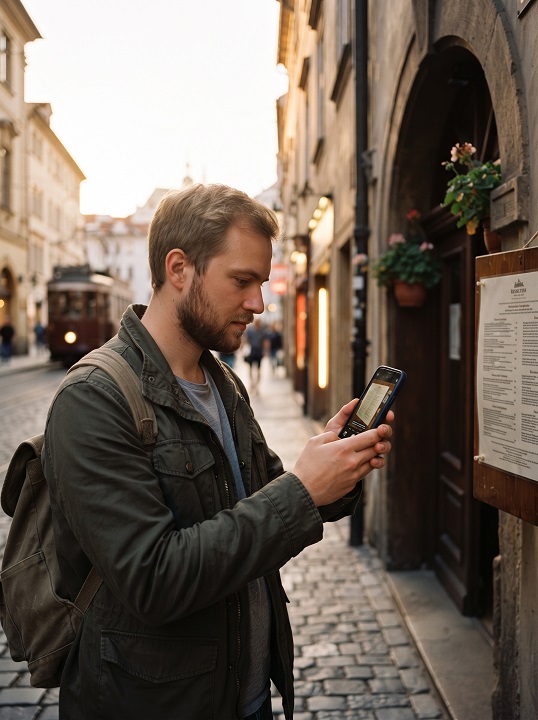
The future arrived without knocking
Once, a paper ticket and a folded map were all the technology a traveller needed. Today, a phone can be your boarding pass, translator, currency calculator, map, camera, travel journal and emergency contact list. That’s extraordinary. It is also a lot of responsibility to place in one pocket.
The important change isn’t simply that our gadgets are getting smarter. It’s that technology is moving from helping us search to helping us decide. And now, increasingly, it can help us act.
AI: the travel companion that never needs a window seat
Artificial intelligence can turn a vague thought—“somewhere interesting, not too expensive, with good trains and fewer crowds”—into a useful starting itinerary. Ask it to compare neighbourhoods, build a realistic three-day plan, suggest rainy-day alternatives or explain unfamiliar local transport. It can translate signs, help draft polite messages and make a complicated destination feel approachable.
That’s the appeal. In its 2026 travel outlook, Deloitte reported that nearly a quarter of surveyed travellers had used generative AI for trip planning by late 2025. The momentum is real, even if the technology isn’t magic.
My advice? Treat AI as a bright, enthusiastic junior travel assistant. It has ideas, never gets tired of your questions and occasionally sounds confident about something it has completely invented. A wonderful colleague—provided somebody checks the work.
Where AI earns its place — and where it doesn't
Good uses: Compare destination styles; build a draft itinerary with rest days; explain a transport system; brainstorm accessible activities; prepare packing lists; translate everyday phrases; and generate questions to ask a hotel or tour operator.
Verify independently: Visa and passport rules, health requirements, opening hours, prices, rail timetables, flight schedules, accessibility promises, refund policies and any booking availability. An AI-generated restaurant recommendation is not a reservation. A persuasive-looking visa answer is not immigration law.
Protect your privacy: Avoid pasting passport numbers, complete booking references, medical records or financial information into a chatbot unless you understand the service’s privacy practices and genuinely need to share them.
Australia’s official Smartraveller service now warns travellers that AI planning tools can give incorrect information and recommends checking important details against official sources.
Try this: make AI plan like a thoughtful traveller
Instead of asking, “Plan me a week in Italy,” give the system useful constraints: “I have seven days, enjoy smaller cities, prefer trains, walk comfortably but don’t want rushed mornings, and need a mid-range budget. Suggest two routes, explain the trade-offs, and flag everything I must verify before booking.”
Then ask the better question: “What have you assumed, and which details might be outdated?” That’s often where the genuinely useful conversation begins.
The smart hotel that called me Citizen Rob
I remember checking into the citizenM hotel at Amsterdam Schiphol some years ago and being amazed. I checked myself in and obtained a key card through a screen. It was fast, simple and, at the time, rather mind-blowing.
Then came the room: a tablet controlling the lighting, blinds, television and ambience. I barely needed to leave the bed to make anything happen. The television welcomed me as Citizen Rob. I felt as though I’d wandered onto a science-fiction set. It was awesome!
That was an early personal glimpse of connected travel technology. Today, app-based check-in, digital room keys and connected rooms are familiar in many properties, although availability varies. And for every delighted guest, there’s another who would prefer a light switch that doesn’t need a software update.

The invisible machinery: data, prices and predictions
Hotels and airlines have long used forecasting and revenue-management systems to adjust prices according to demand, booking patterns, seasonality and other factors. Machine learning can improve those forecasts, but it doesn’t follow that every price change is an AI conspiracy—or that the traveller always wins.
Dynamic pricing can make an off-peak stay attractive while pushing busy dates beyond your budget. Compare the total price, including baggage, taxes, transfers and cancellation conditions. A cheaper number on the first screen is not necessarily a cheaper trip.
The internet of things — and the bag that tells on itself
The Internet of Things, or IoT, means physical devices exchanging data through connected systems. Think smart hotel controls, connected airport equipment and baggage tracking.
Airline bag-tracking systems and personal Bluetooth trackers can provide useful clues about where luggage is, though neither guarantees that a delayed bag will arrive on the next carousel. Check airline and battery rules before putting trackers in checked baggage.
Biometric identity checks and digital travel credentials are another developing area. They can make some airport processes faster, but systems, eligibility, privacy safeguards and alternatives vary widely by country and operator.
Will AI eventually book the entire trip?
We are moving toward systems that can search, compare and sometimes carry out parts of a booking workflow. But the leap from suggesting a good hotel to spending your money is significant. Permissions, accurate availability, payment security, accessibility and consumer protection all matter.
In 2026, it’s sensible to think of automated booking as an emerging capability rather than something to trust blindly. Review the actual supplier, final price, dates, room or seat type, and cancellation rules before approving any purchase.
What technology cannot give us
There is a danger in making travel so frictionless that we remove the very things that make it memorable. An algorithm can tell you which café is highly rated. It cannot guarantee the wonderful conversation with the person at the next table. It can build a route through a city. It cannot decide which unexpected alley will make you fall in love with the place.
Technology should give us more room for curiosity, not replace curiosity with instructions. Let the phone solve the timetable. Then put it away long enough to notice where you are.
My practical rules for travelling with technology
Before departure: Save offline maps and copies of essential documents securely; confirm entry rules with official authorities; install needed transport apps; and carry a charging backup.
On the road: Use AI for ideas and explanations, not unverified emergencies or legal decisions. Cross-check live details with the airline, rail operator, hotel or government source. Be careful with public Wi-Fi and unexpected payment links.
When things go wrong: Keep an offline address, an alternative contact method and enough independence to manage without your phone. A dead battery should be an inconvenience, not the end of your holiday.
The question worth asking
AI will undoubtedly change how we discover places, how travel businesses serve us and how easily we navigate unfamiliar surroundings. Whether it makes us better travellers is a different question.
Perhaps the best future is one where technology takes care of the tedious bits—and leaves us free to be wonderfully human in the interesting ones.
What do you think? Would you let AI plan your next holiday? Would you trust it to book? Tell me where you’d draw the line in the comments.
Further reading and useful checks
For research and official guidance: Deloitte’s 2026 travel outlook; Smartraveller’s AI planning guidance; and McKinsey on AI travel planning.
Keep exploring: Best Travel Apps · Travel tech & power · Travel Logistics & Transit · Start World Travel.
2 Responses
I have just spent close to an hour scanning your website. I love the variety of articles and generally your writing style – some better than others. I will be back. Interesting stuff
Thanks, Arthur. Glad you like it. I will be uploading plenty of new articles on a regular basis