 As a white South African who grew up in Johannesburg during the apartheid era, the name of Nelson Mandela was as unknown to me as it was to most of the world.
In fact, the world knew more of Nelson Mandela then we did in South Africa.
If Mandela’s name was ever mentioned, it would have been alongside the names of others and lost in the generic terms of terrorist and the Rivonia trial.
As a population, at the time of Nelsons imprisonment, we knew only what we were allowed to know. Our news was censored and TV was banned.
To know such names as Nelson Mandela as a white person would suggest a suspicious empathy and revolutionary thought process that was punishable with Pretoria Central Prison or sudden disappearance.
As a child, had you asked me who Nelson Mandela was, I would have said, “Nelson who?”
Our ignorance in the apartheid era, especially as children, was profound. We knew nothing of Mandela, Ahmed Kathrada, Govan Mbeki, Denis Goldberg , Biko, Walter Sislu and the ANC. We knew only of bad men who wanted to hurt us and those bad men were black.
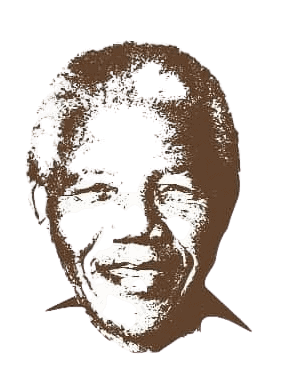
There was a time when I knew nothing of this man and yet I have witnessed and lived the power of his reconciliation. His unbelievable and magnanimous gesture to preach peace when he could have justifiably pontificated violence and retribution, to this day astounds me.
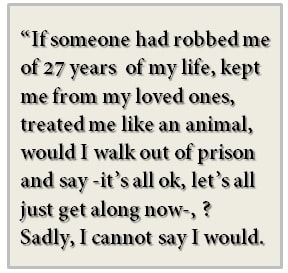
If someone had robbed me of 27 years of my life, kept me from my loved ones, treated me like an animal, would I walk out of prison and say “it’s all ok, let’s all just get along now” ?
 Sadly, I cannot say I would. I remember the places and things I saw as a child with uneasy clarity.
Many people cannot understand how white South Africans could live with the knowledge that their privileged existence came at the expense of disenfranchised millions.
What people do not comprehend is that we grew up to think this was all normal. We knew of black people as our maids and gardeners. We knew their first name and not their last. We knew that some black people could hurt us and we needed to be careful.
While I wrote this article some time ago, it seems pertinent at this time, when at last the world seems to be waking up to what has always needed fixing – systemic racism. Perhaps, along with my countrymen, I can appreciate what is being said in a very personal way.
Growing up as a child, racism was not a choice. It was a natural implementation. Racism to a child in apartheid South Africa was like learning a language. It came naturally and without choice. You learned it everyday.
There were different grades of racism. There was the aggressive and angry racism that most of us considered was exclusive to the Boers. (not true) and then there was the quiet acceptance that people of color were different. Ours, in white English society was the latter. Quiet and insidious.
Somehow we did not connect people of color with their own needs and wants. If our maid lived with us, she was a part of the family structure but we knew nothing of her family.
It did not cross our minds that she had a family or children. She was a lower ranked part of our unit and that was all we knew.
It was totally acceptable to us that the maid or the gardener would have their own mug for tea. It would be a tin mug.
The plate upon which thick slices of bread and jam were spread as a sugar laden lunch, belonged only in the scullery, away from our china.
There was a designated workers station of plates and mugs. This low profile racism was as bad as outward aggressive racism. Perhaps it was worse because we treated our ‘servants’ with kindness.
Laughable to suggest that there was any kindness in wanton disregard of someones existence beyond their function, but it was this conditioning that plagued all white South African children growing up in this era.
What of our parents? Did they not know better? Yes, they did, in most cases. Both my parents had emigrated from England to the then Rhodesia (Zimbabwe).
They were the colonial English – a bi-product of an extremely racist England at the time when Enoch Powell lectured his xenophobia to all who would listen.
Rhodesia was the typical colonial outpost – white lace and prejudice abounded. English parent emigres were as conditioned as their off-spring. But they did know better. They knew that the inequality was an uncomfortable issue that was not spoken of.
 I recall my mother and father talking quietly of the politics and immediately stopping conversation when my presence was noticed.
Dad was paranoid, as were most English speaking whites, that any liberal speak would be immediately punished by the State.
You see, what few outsiders would know is that being white in apartheid South Africa was not a guarantee of immunity.
English speaking whites had their own fears of the government. To be English in a predominantly Afrikaans society was a prejudiced position as well.
Whilst we had all the trappings of privilege, we were afforded this with our quiescence.
We were sell-outs and our parents knew it. Silence, in itself was violence. This is not to suggest that all English speaking South Africans were closet liberals stifled in expression by a fascist-like regime.
These English were as liberal as it suited them. If the wind shifted, so would their politics. It was easy street in many ways. However, pseudo-decency was upheld in the guise of the kindness to the Africans.
And there was the irony – we referred to blacks as ‘Africans’, as if to suggest we knowingly were the unwelcome guest in the continent in which we did not really belong.
We never referred to ourselves as Africans. We were simply there. Not British, not African and not even South African. Simply there.

What an amazing piece of writing. It says exactly what we have probably never vocalized as white South Africans. Your writing captures the essence of my childhood exatly!