Viking river cruises · Amsterdam ↔ Budapest
Viking Grand European Tour: Amsterdam ↔ Budapest
I’d be careful about turning this journey into a competition to see how much Europe you can collect in a fortnight. There are castles, cathedrals and grand capitals, certainly. There are also quiet stretches of river, small towns and perfectly good reasons to stop for a coffee.
The trick is knowing when to get moving and when to stay in your seat and enjoy the view. This guide walks you through the Viking Grand European Tour day by day, from Amsterdam to Budapest and back the other way.
By Rob Wheatley · Viking Program Director
What is the Grand European Tour?
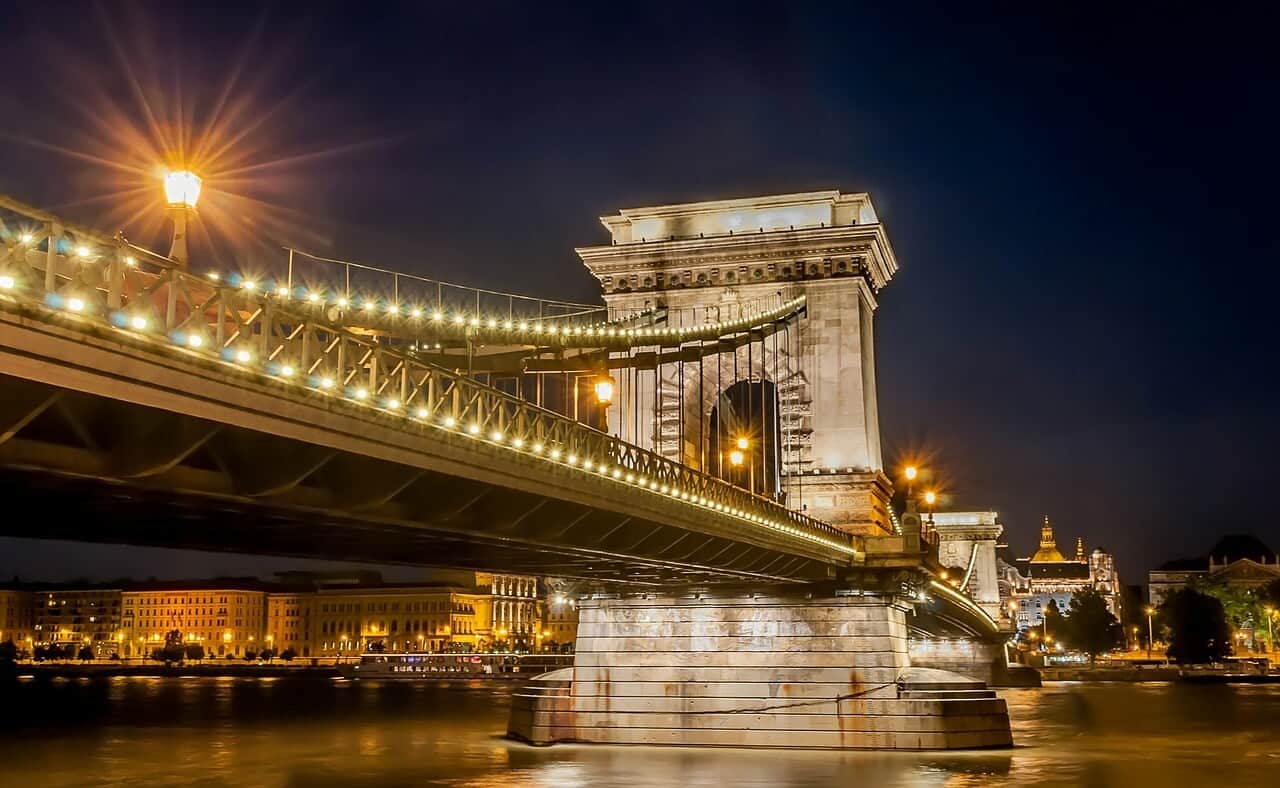
Viking’s Grand European Tour connects Amsterdam and Budapest through the Netherlands, Germany, Austria and Hungary. The Rhine, Main and Danube give it three distinct river settings, with the Main–Danube Canal providing the link between river systems.
The appeal is the variety: Dutch windmills, the Middle Rhine’s castles, Franconian towns, the Wachau Valley and the scale of Vienna and Budapest. I’d choose this if you enjoy a changing landscape and a busy menu of places, with the ship providing a familiar base.
That does not mean every day needs to be full. Over two weeks, the occasional slower afternoon can improve the rest of the trip considerably. A chair, a view and something to drink are also legitimate travel activities.
Choose your direction first
The two versions are not simply the same list read backwards. In Viking’s published programmes, Amsterdam → Budapest includes Miltenberg and lists Krems alongside the Melk and Wachau day. Budapest → Amsterdam lists Wertheim and a Wachau and Melk day.
Open the appropriate itinerary below. These are planning outlines, based on Viking’s published 2027 routes checked on 7 November 2026. Your booked departure, excursion descriptions and daily programme confirm the arrangements, timings and any changes.
A highlight between the destinations
The big climb: taking your floating hotel over Europe
Castles and cathedrals get the photographs, but I would give the locks some attention too. On this voyage, your ship climbs to around 1,330 feet (406 metres) above sea level at the Main–Danube Canal summit. That is the high point of Europe’s connected commercial inland waterway network. Your floating hotel crosses a watershed, and your coffee barely notices.
From the North Sea side to the Black Sea side
The canal connects the Main at Bamberg with the Danube at Kelheim. Its summit section carries the ship across the European watershed between the Rhine and Danube drainage basins. On Amsterdam → Budapest, you climb from the Main side, cross the summit and descend towards the Danube, whose waters ultimately reach the Black Sea. On Budapest → Amsterdam, you climb from the Danube side and descend towards the Main and Rhine, which lead towards the North Sea.
So both directions include a climb and a descent. The canal itself is a managed, pumped waterway; crossing the watershed does not mean the whole canal suddenly starts flowing in the opposite direction.
It is a lot of elevator for a boat that thinks it is a hotel
The canal has 16 locks. At Leerstetten, Eckersmühlen and Hilpoltstein, the level changes by about 81 feet (24.67 metres) in a single chamber. Watching the wall rise beside your window—or disappear below it—makes the engineering rather less abstract.
A lock is essentially a chamber with gates at each end. The ship enters, the gates close behind it and the water level is raised or lowered until it matches the next stretch. Then the other gates open and the voyage continues. No wheels, no giant crane: the ship floats as the water changes level.
The squeeze: inches to spare
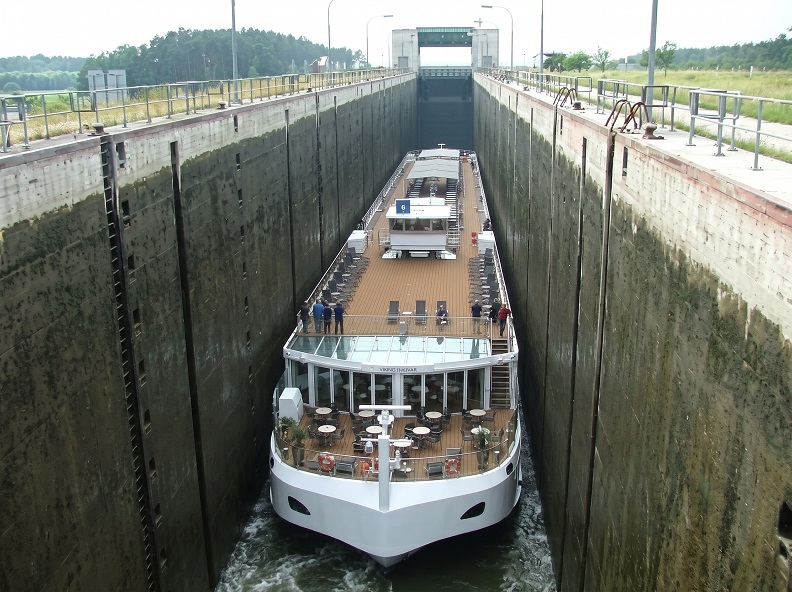
A standard Rhine–Main–Danube Viking Longship is about 443 feet long and 37½ feet wide (135 by 11.45 metres). The canal’s lock chambers are about 623 feet long and 39 feet wide (190 by 12 metres). There is useful room lengthwise, but the width is another matter.
Subtract those published widths and you get about 22 inches (55 centimetres) of total spare width: roughly 11 inches (27.5 centimetres) on each side if the ship is perfectly centred. That is a simple comparison of dimensions, not a guaranteed measured gap throughout the manoeuvre. Either way, the captain is parking a hotel with considerably less sideways room than most of us would request for a car.
Why the sundeck sometimes closes
Of course, everyone wants a good view. But low bridges and overhead structures mean the ship must sometimes lower its wheelhouse, railings and deck equipment. The sundeck can be closed for extended stretches of the Main and canal, rather than only for the few minutes inside a lock.
Follow the crew’s instructions and watch from an authorised open area. Sometimes your stateroom window supplies an unusually intimate introduction to a concrete wall. Keep hands, cameras and anything else inside the ship’s boundaries. The captain decides when deck access can safely resume.
The Danube has its own mechanical choreography
Beyond the canal, the voyage continues through locks associated with Danube hydropower stations. Around the German–Austrian border and through Austria, names include Jochenstein, Aschach, Melk, Altenwörth, Greifenstein and Freudenau near Vienna, with other locks between them. Many change the level by roughly 33–55 feet (10–17 metres), so they are substantial operations too.
Gabčíkovo, in Slovakia between Bratislava and Budapest, is another impressive installation. It is the last lock complex before Budapest when travelling downstream from Vienna; on the reverse voyage, you encounter it before reaching Vienna. Passing through Slovakia’s waterways does not imply a scheduled stop in Bratislava.
My practical advice: watch one properly, then let the river happen
Ask which locks are likely to pass in daylight and where you may watch. I’d see one complete passage rather than repeatedly arrive just as the gates open. With deck access permitted, it is a fine excuse for a coffee and a little mechanical theatre.
Traffic, lock scheduling, water conditions and maintenance can affect the wait. “We’ll be through shortly” is a hopeful phrase, not a stopwatch reading. Some passages happen overnight or while you are ashore, so do not expect to witness every lock.
The canal’s 16-lock count is fixed; the full voyage includes additional locks on the Main and Danube. Use the ship’s daily programme and announcements for the sequence you will experience and the best viewing opportunities.
Engineering references: Main–Danube Canal facts, German waterways authority canal atlas, Longship builder’s dimensions, viadonau lock operations and Danube Commission lock data. Dimensions are approximate for travel planning, not navigation.
Your journey, day by day
Choose your sailing direction below. Use “Discover the destination” to open the city and regional guides.
Amsterdam → Budapest · 15-day itinerary
Day 1
Amsterdam · Embarkation
Arrival day is for finding your feet, finding your ship and remembering where you put your passport. Once you have checked in, see how much energy and time you actually have before making plans ashore. Amsterdam’s canals and museums deserve more than a hurried glance, so I’d add time here if the city is a priority. Don’t assume embarkation day provides a full day of sightseeing.
Day 2
Kinderdijk · Dutch waterways
Kinderdijk’s windmills make a lovely photograph, but the story of keeping this landscape dry is what gives them meaning. Listen to the explanation before disappearing behind your camera. The day also includes sailing on the Waal and Merwede. Dress for an exposed waterside setting, with a layer you can put on when the breeze decides to join the excursion.
Day 3
Cologne
The cathedral is the obvious landmark, and quite rightly. Afterwards, I’d leave some room for the streets around it rather than trying to conquer Cologne in one afternoon. If you fancy a Kölsch, check the serving customs before settling in: those small glasses can keep arriving. Confirm your return time and berth before heading off independently.
Day 4
Koblenz · Middle Rhine sailing
Koblenz brings you to the meeting of the Rhine and Moselle; the Middle Rhine then gives the journey its castle-lined scenery. This is a day to check the programme before booking yourself into something that keeps you away from the windows. Find a comfortable viewpoint, keep a layer handy and enjoy the river. The scenery is part of the trip, not a screensaver between towns.
Open the destination guide →Day 5
Main River sailing · Miltenberg
The pace changes on the Main. There is sailing through the Spessart area and a visit to Miltenberg, with its half-timbered buildings and Old Town streets. I’d enjoy the smaller scale here. You do not need a famous capital every morning to have a good day in Europe. Comfortable shoes remain more useful than stylish shoes with a grudge against cobblestones.
Day 6
Würzburg
The Bishops’ Residenz is the major architectural draw. If you are planning additional sightseeing, first check what your booked excursion covers and how much independent time remains. I’d rather give one impressive interior my attention than spend the day counting attractions. Leave room for the city itself, and perhaps a taste of Franconian wine.
Open the destination guide →Day 7
Bamberg · Main–Danube Canal
Bamberg’s Old Town rewards looking up, looking around and occasionally stopping altogether. Its smoked beer is another talking point: Rauchbier is distinctive enough that you will probably form an opinion quite quickly. Viking also lists Main–Danube Canal sailing on this day. Treat the canal and its locks as part of the story of how this journey across Europe works.
Open the destination guide →Day 8
Nuremberg
Nuremberg asks for more than a pretty-picture approach. Medieval streets sit alongside a difficult twentieth-century history. Read the excursion description carefully so you know its focus; a panoramic tour, an Old Town walk and a specialist historical visit are different experiences. Choose additional activities for what interests you rather than assuming every tour covers everything.
Open the destination guide →Day 9
Regensburg
Regensburg is a good place to let the streets do some of the work. The medieval centre, cathedral and river setting provide plenty to notice without adding a frantic checklist. After the guided visit, I’d pick a manageable area to explore and allow time to sit down. A little unplanned time is often where a place becomes more than its headline sight.
Day 10
Passau
Passau brings an attractive Old Town and its richly decorated cathedral into the journey. Follow the included visit, then decide whether you want another sight, a riverside stroll or simply a break. If an organ performance matters to you, verify the actual schedule and your excursion arrangements rather than assuming a concert happens whenever a ship arrives.
Day 11
Melk · Wachau Valley · Krems
Viking’s Amsterdam-to-Budapest programme lists Melk, scenic Wachau sailing and Krems on this day, including references to Melk Abbey and Göttweig Abbey. Read your own excursion options closely before deciding how to spend it. I would make room for the valley views as well as the buildings. Check which visits are included, which are optional and how the day is organised.
Day 12
Vienna · First day
Vienna has enough imperial architecture, music and museums to make a determined sightseer slightly unreasonable. Start with the included programme, then choose what matters most to you. I’d resist filling both Vienna days before thinking about travel time between activities. A café break belongs in the plan too; it does not have to be earned by visiting three museums.
Day 13
Vienna · More time to explore
Use the second Vienna day to follow your interests. Art, palaces, music or a slower wander can each make a satisfying day. If you want a particular concert or museum, check ticket availability and the ship’s schedule before paying. Do not assume that two days listed in Vienna means two unrestricted evenings ashore.
Day 14
Budapest · Explore
Budapest deserves attention on both sides of the Danube. Use your guided visit to get your bearings, then choose a realistic extra outing. The Castle District involves different walking demands from a gentle promenade, so read the activity information. I’d avoid making the last sightseeing day an endurance event. Leave time to enjoy the view and digest what you have seen.
Day 15
Budapest · Disembarkation
This is the departure day, not a guaranteed bonus day in Budapest. Your flight and transfer may leave little room for anything beyond breakfast and farewells. If you want thermal baths, museums or a proper independent wander, add nights rather than trying to squeeze them between packing and an airport transfer.
Budapest → Amsterdam · 15-day itinerary
Day 1
Budapest · Embarkation
Settle aboard and find out what your arrival time realistically allows. Budapest is a substantial city; I would not judge the available sightseeing time by the number of times its name appears on the itinerary. If it is one of your main reasons for travelling, arrive earlier and give yourself room to enjoy it.
Day 2
Budapest · Explore
Use the city programme to understand Buda and Pest, then choose an extra experience that fits your energy and schedule. A thermal bath visit needs more thought than simply taking a towel: check opening arrangements, travel time and what you need to bring. Keep the ship’s departure time firmly in the plan.
Day 3
Vienna · First day
Vienna has enough imperial architecture, music and museums to make a determined sightseer slightly unreasonable. Start with the included programme, then choose what matters most to you. I’d resist filling both Vienna days before thinking about travel time between activities. A café break belongs in the plan too; it does not have to be earned by visiting three museums.
Day 4
Vienna · More time to explore
Use the second Vienna day to follow your interests. Art, palaces, music or a slower wander can each make a satisfying day. If you want a particular concert or museum, check ticket availability and the ship’s schedule before paying. Do not assume that two days listed in Vienna means two unrestricted evenings ashore.
Day 5
Wachau Valley · Melk
This direction lists scenic Wachau sailing and Melk. Enjoy the hillside vineyards and riverside scenery, then give the abbey visit the attention it deserves if that is your chosen programme. Do not copy the opposite direction’s Krems arrangements into your plans: the published sequences differ.
Day 6
Passau
Passau brings an attractive Old Town and its richly decorated cathedral into the journey. Follow the included visit, then decide whether you want another sight, a riverside stroll or simply a break. If an organ performance matters to you, verify the actual schedule and your excursion arrangements rather than assuming a concert happens whenever a ship arrives.
Day 7
Regensburg
Regensburg is a good place to let the streets do some of the work. The medieval centre, cathedral and river setting provide plenty to notice without adding a frantic checklist. After the guided visit, I’d pick a manageable area to explore and allow time to sit down. A little unplanned time is often where a place becomes more than its headline sight.
Day 8
Main–Danube Canal · Nuremberg
Viking lists canal sailing and Nuremberg together on this day. The canal is the engineering link that makes a Rhine-to-Danube journey possible. In Nuremberg, check the historical focus and walking demands of your chosen tour. Some subjects deserve time to absorb rather than another quick photograph.
Open the destination guide →Day 9
Bamberg
Bamberg’s Old Town rewards looking up, looking around and occasionally stopping altogether. Its smoked beer is another talking point: Rauchbier is distinctive enough that you will probably form an opinion quite quickly.
Open the destination guide →Day 10
Würzburg
The Bishops’ Residenz is the major architectural draw. If you are planning additional sightseeing, first check what your booked excursion covers and how much independent time remains. I’d rather give one impressive interior my attention than spend the day counting attractions. Leave room for the city itself, and perhaps a taste of Franconian wine.
Open the destination guide →Day 11
Wertheim · Main River sailing
The Budapest-to-Amsterdam programme lists Wertheim, rather than the Miltenberg stop shown in the other direction. Its glassblowing traditions and compact historic setting give this part of the route a different emphasis. The day also includes Main River sailing through the Spessart area. Enjoy the change of pace rather than treating a small town as a lesser day.
Day 12
Middle Rhine sailing · Koblenz
The castle-lined Middle Rhine comes before Koblenz in Viking’s published sequence for this direction. Keep an eye on the daily programme so you can be ready for the scenic stretch. Afterwards, Koblenz offers a chance to explore the meeting point of the rivers and its Old Town. Check the berth and meeting arrangements before wandering.
Open the destination guide →Day 13
Cologne
The cathedral is the obvious landmark, and quite rightly. Afterwards, I’d leave some room for the streets around it rather than trying to conquer Cologne in one afternoon. If you fancy a Kölsch, check the serving customs before settling in: those small glasses can keep arriving. Confirm your return time and berth before heading off independently.
Day 14
Dutch waterways · Kinderdijk
Viking lists Waal and Merwede sailing followed by Kinderdijk. The windmills make a memorable final excursion, with a practical story about water management behind the familiar Dutch scene. Check the weather and bring a layer. Save some energy for packing later; the suitcase has an uncanny habit of becoming less cooperative at the end of a trip.
Day 15
Amsterdam · Disembarkation
Your final day is primarily for disembarkation and onward travel. If you want the Rijksmuseum, a canal cruise or time to explore Amsterdam properly, I’d add a stay after the cruise. A city name on departure day is not a promise of sightseeing time.
Which direction would I choose?
I’d start with flights, the time you want before and after the cruise, and which city you most want to explore independently. You are not choosing between a good journey and a poor one. You are choosing how you would like it to unfold.
| Think about | Amsterdam → Budapest | Budapest → Amsterdam |
|---|---|---|
| Your first days | Dutch waterways, then the Rhine and Main | Budapest and Vienna, then the Danube |
| Published Main River town | Miltenberg | Wertheim |
| Time after the cruise | Extend in Budapest | Extend in Amsterdam |
Whichever you choose, I’d give serious thought to extra time in your starting city. It gives you a chance to explore without asking an overnight flight and an embarkation day to do all the work.
Do not miss the sailing while planning the sightseeing
The Middle Rhine and Wachau are major reasons to take this route. Check the programme and decide where you want to watch from. Bring binoculars if you enjoy looking closely, and keep your camera ready without spending the entire passage looking through it.
For the canal summit, lock passages and temporary sundeck closures, see the big climb and what it feels like aboard. I’d plan on enjoying some views from the lounge or my stateroom, with deck access determined by the captain.
A few practical things I’d sort out before travelling
- Read the excursion description, not only its title. Check walking distance, steps, uneven surfaces and time on a coach. A panoramic visit and an extended walking tour can ask very different things of you.
- Give yourself breathing room. An included excursion followed by an optional outing every day may sound splendid at home. By the second week, your feet may have submitted a different proposal.
- Confirm where the ship will be. River berths and meeting points can change. Take the contact information and follow the crew’s return instructions before exploring independently.
- Keep arrival essentials with you. Medication, documents, chargers and a light layer belong in your hand luggage. Check your joining instructions for boarding and transfer arrangements.
- Separate included visits from paid extras. Viking advertises 12 guided tours on this itinerary, but that does not make every attraction or excursion complimentary. Check your own booking and available excursions.
- Allow for a working river. Water levels, locks and other operating conditions can affect a programme. Keep independent arrangements flexible where possible and pay attention to updates from the ship.
Arrival days, departure days and adding a little time
A day labelled Amsterdam or Budapest can mean joining or leaving the ship. It does not automatically mean a full day to explore. This is where I’d look beyond the headline number of days and read the actual sequence.
Viking offers pre- and post-cruise extensions, with availability depending on direction and departure. You can also consider an independent stay. Compare the arrangements, transfers and total cost before deciding; neither approach is automatically the better choice for everyone.
If your plans involve a hotel, be ready for the gap between an early flight arrival and afternoon room availability. Ask about luggage storage, keep valuables and medication with you, and choose a gentle first outing. I would aim for a coffee and a little fresh air before attempting a cultural marathon.
Make more of your time ashore
Use the destination guides to choose a priority, judge the walking and leave a little space for the unexpected. The city and regional guides connect directly from the relevant days above, with separate Viking guest notes where available.
My take
The strength of the Grand European Tour is the way Europe changes around you. I’d enjoy the big landmarks, certainly, but I would leave room for the quieter pleasures too: a small-town square, a good conversation, a stretch of river with nothing urgent to do.
Choose a few priorities. Take the useful advice. Then let yourself enjoy being there. You do not get extra points for arriving home exhausted.
Sources and itinerary check
Route sequences checked against Viking’s official Amsterdam → Budapest itinerary and Budapest → Amsterdam itinerary on 7 November 2026. Itineraries and shore excursions may change by departure. Prices, promotions and precise sailing times are deliberately left to Viking’s current booking information.
These are my own observations and suggestions as a Viking employee, rather than an official company statement or an independent paying-passenger review.
Which part of the journey has caught your eye?
Have you sailed the Grand European Tour in either direction? Tell us which stop or stretch of river stayed with you—or ask the practical question you want answered before you travel.
Join the conversation below ↓