MAIN GUIDE · BUDGET TRAVEL · SPEND SMARTER
How to Travel Cheap Without Feeling Deprived
How to travel cheap is not about turning every trip into a punishment exercise with bad coffee, terrible beds, and a heroic amount of suffering. It is about spending less on the things that do not matter, so you can protect the parts of travel that keep you safe, rested, fed, and still speaking nicely to people by day four.
Cheap is a strategy, not a personality. The trick is not to become stingy. The trick is to stop leaking money through panic, tiredness, poor planning, and those little “oh well, we’re already here” decisions that quietly mug your wallet in broad daylight.
Quick Overview
What this guide helps you do
This guide helps you travel cheaper without stripping the joy out of the trip. The aim is not the lowest possible price at any cost. The aim is better value, fewer expensive mistakes, and a trip that still feels like something you chose rather than something you survived.
The big idea is simple: protect the basics, flex the rest, and stop making money decisions when you are hungry, tired, lost, or standing outside a train station with luggage and a face full of regret.
The cheap travel principle
- Protect: safety, sleep, basic food, recovery, and essential transport.
- Flex: views, brands, room size, upgrades, convenience extras, and impulse spending.
- Choose: one or two splurges that genuinely improve the trip.
- Avoid: false savings that create bigger costs later.

The reframe
Cheap travel is not a suffering contest
Somewhere along the line, budget travel picked up a strange badge of honour. The worse the bed, the more authentic the trip. The longer the walk with luggage, the more noble the savings. The more you suffer, the more “real” the travel.
Nonsense. I have no interest in romanticising discomfort for its own sake. I have seen enough tired travelers make bad choices to know this: the cheapest option is not always the cheapest once real life joins the room.
Rob’s rule: a good budget protects your energy. A bad budget spends your energy and then charges you later to get it back.
So, yes, we are going to save money. But we are going to do it with a grown-up brain, not with a badge that says, “I ruined my holiday and saved $12.”
Follow the money
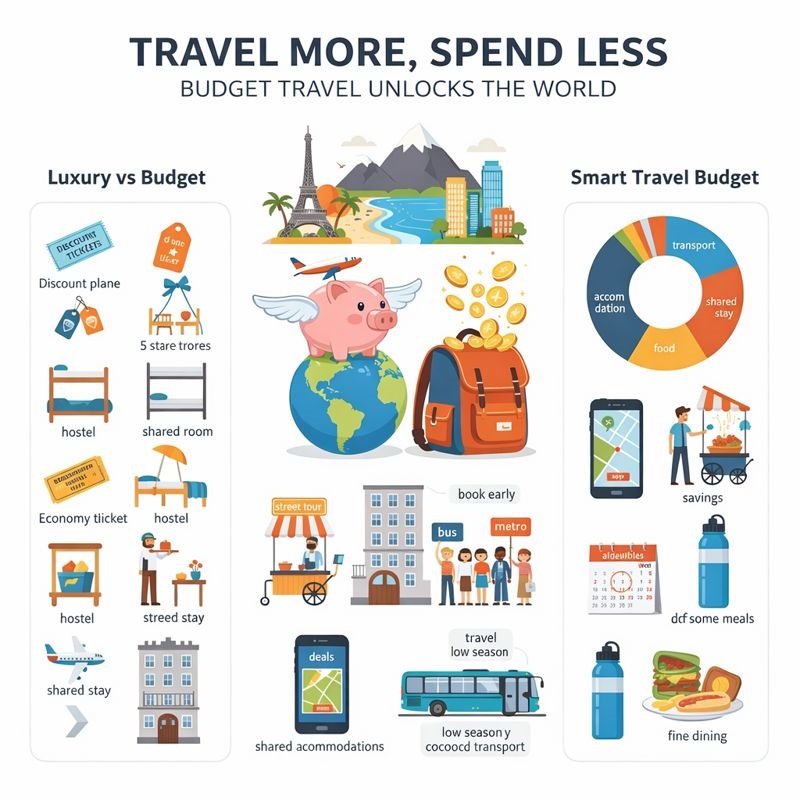
Where travel money actually goes
If you want to travel cheap, stop obsessing over tiny savings first. A cheaper coffee is nice. However, one poor flight choice, one badly located hotel, or one exhausted taxi rescue can wipe out a week of tiny victories.
The big money usually hides in four places: transport, accommodation, food, and what I call “oops spending.” That last one is the silent killer. It appears when you are tired, rushed, hungry, confused, or trying to fix a planning mistake with money.
Big levers
Flights, accommodation location, transport choices, luggage fees, and booking timing.
Small leaks
Snacks, taxis, tourist restaurants, currency mistakes, add-ons, and “just this once” upgrades.
The choices that matter
The smart way to travel cheaper
This is the practical middle ground. Not “cheapest everything.” Not “treat yourself until the card weeps.” Just better decisions in the places that move the budget.
Choose timing before deals
A deal on the wrong dates can still be expensive. Travel cheaper by checking shoulder seasons, midweek flights, and realistic arrival times before falling in love with a price.
Plan the trip shape firstStay where transport makes sense
The cheapest room can become expensive if it adds taxis, long transfers, bad sleep, or lost time every day. Location is not a luxury detail. It is part of the budget.
Plan smoother transportEat simply, not sadly
Grocery breakfasts, local bakeries, markets, and one proper meal can keep costs down without making food feel like an accounting punishment.
Explore food travel ideasPack lighter than your fear
Bags cost money, slow you down, and reduce your options. Lighter luggage gives you cheaper movement, easier transit, and fewer “I give up” moments.
Read packing guidancePick your splurge early
One memorable paid experience beats ten vague little upgrades. Choose what matters, protect it, and cut the low-value extras around it.
Reconnect with travel inspirationBuild a small buffer
A budget with no buffer is not disciplined. It is fragile. Give the trip a little breathing room so one surprise does not become a crisis.
Understand travel costsDifferent trips, different savings
How cheap travel changes by trip type
The basic principles stay the same, but the biggest savings move around. A city break is not a road trip. A cruise is not a backpacking route. A long journey is not a weekend with a suitcase pretending to be small.
City breaks
Choose walkable areas, use public transport, keep breakfasts simple, and pay for one proper “wow” moment.
Plan cheaper city breaks →Road trips
Fuel, parking, food stops, and overnight choices are the big levers. Romantic spontaneity still needs petrol.
Build a road trip budget →Cruises
The fare is only the beginning. Watch cabins, drinks, excursions, transfers, gratuities, and pre-cruise hotels.
Cruise on a budget →Long trips
Slow travel, weekly routines, lighter packing, and fewer rushed transfers can save serious money.
Plan long-term budget travel →Avoid the traps
Expensive “cheap travel” mistakes
The most expensive budget travel mistakes usually begin with good intentions. You choose the cheapest option, feel clever for five minutes, and then spend the next day paying for the friction.
Cheap travel becomes expensive when it ignores human limits. You can save on a hotel. You cannot save on sleep forever. You can walk instead of taking transport. You cannot walk yourself out of complete exhaustion with luggage and a bad mood.
Random deal addiction
A deal without a plan can create awkward routes, extra nights, and hidden costs.
Cutting the wrong thing
Unsafe areas, bad sleep, and poor food often lead to expensive fixes later.
No arrival plan
The first day can become costly fast when you are tired, lost, and making decisions on fumes.
The false saving
If saving $20 creates $80 of stress, transport, or recovery spending, it was not a saving.

Practical tool
The Budget Spine: protect the trip, flex the rest
The Budget Spine is a simple way to stop treating every cost as equal. Some costs protect the trip. Others are optional. Once you know the difference, it becomes much easier to travel cheap without feeling deprived.
Sleep
- Safe location
- Clean room
- Enough quiet to recover
- Room size
- View
- Brand name
Food
- Safe water
- One solid meal
- Food that keeps you functional
- View restaurants
- Alcohol
- Hotel breakfasts
Movement
- Safe arrival transport
- Realistic connection times
- Luggage you can manage
- Private transfers
- Premium seats
- Short-distance flights
The golden rule
Never cut from the Spine to pay for the Flex. Do it the other way around. Cut the shiny extras first, and protect the parts that keep the trip stable.
Before you book
Official checks that can save real money
Good budget travel is not only about finding cheaper prices. It is also about avoiding avoidable costs: wrong documents, missed rules, baggage surprises, health problems, and passenger-rights confusion.
Before you commit money, check the boring official sources. Boring is beautiful when it saves you from buying a second flight.
Where to go next
Choose your next budget travel step
Do not try to fix every cost at once. Pick the next useful decision and keep moving.
Plan for Travel
Get the trip shape right before you start chasing prices.
Plan the trip properly →Cost to Travel the World
Understand realistic travel costs before the numbers surprise you.
See travel costs →Transit & Comfort
Save money by moving smarter, lighter, and with fewer panic decisions.
Improve the travel days →Destinations
Choose places that fit your budget, time, and travel energy.
Browse destinations →A quick clarification
What this cheap travel guide is not
This is not a promise of “$10 a day anywhere,” and it is not a list of fragile hacks that work only once. Prices change. Rules change. Your body also occasionally has opinions.
- Not cheapest everything.
- Not advice that ignores safety, health, or rest.
- Not a destination list pretending to be a budget guide.
- Not a rigid plan that collapses the moment life happens.
Q & A
Budget travel questions people actually ask
How do I travel cheap without feeling deprived?
Protect the essentials first: safe sleep, basic food, arrival transport, and recovery. Then cut from the flexible areas such as room views, brands, upgrades, impulse spending, and tourist convenience pricing.
What is the best way to travel on a budget?
Start with the trip shape before chasing deals. Decide your time, destination fit, transport style, accommodation needs, and food rhythm. Then look for savings inside that structure.
Is the cheapest option always best?
No. The cheapest option can become expensive if it creates poor sleep, unsafe transport, long transfers, luggage problems, missed connections, or burnout spending.
Where do travelers usually overspend?
Transport, accommodation, food, luggage, last-minute fixes, and convenience purchases. Many overspends happen when people are tired or trying to rescue a poor plan.
Can cruises be done on a budget?
Yes, but you need to watch the extras: cabin choice, drinks, excursions, transfers, specialty dining, gratuities, and pre- or post-cruise hotels. The fare is only one part of the total cost.
Join the conversation
Where do you overspend most when you travel: sleep, food, transport, luggage, excursions, or those little “surprise” costs that appear when you are tired? Drop a comment. I read them, and they often turn into future guides.