TRAVEL FIELD NOTES · THE OPEN ROAD
Road Trip Budget: Plan the Miles, Keep the Fun
The open road is free. Almost everything you need to enjoy it has found a way to charge.
I have done the “cheap road trip” that turned into snacks, detours, late arrivals and last-minute accommodation. A useful road trip budget accounts for the whole journey, then gives you enough breathing room to enjoy it. Here is how I would build one.
By Rob Wheatley – Program Director & traveler
Updated 17 October 2026
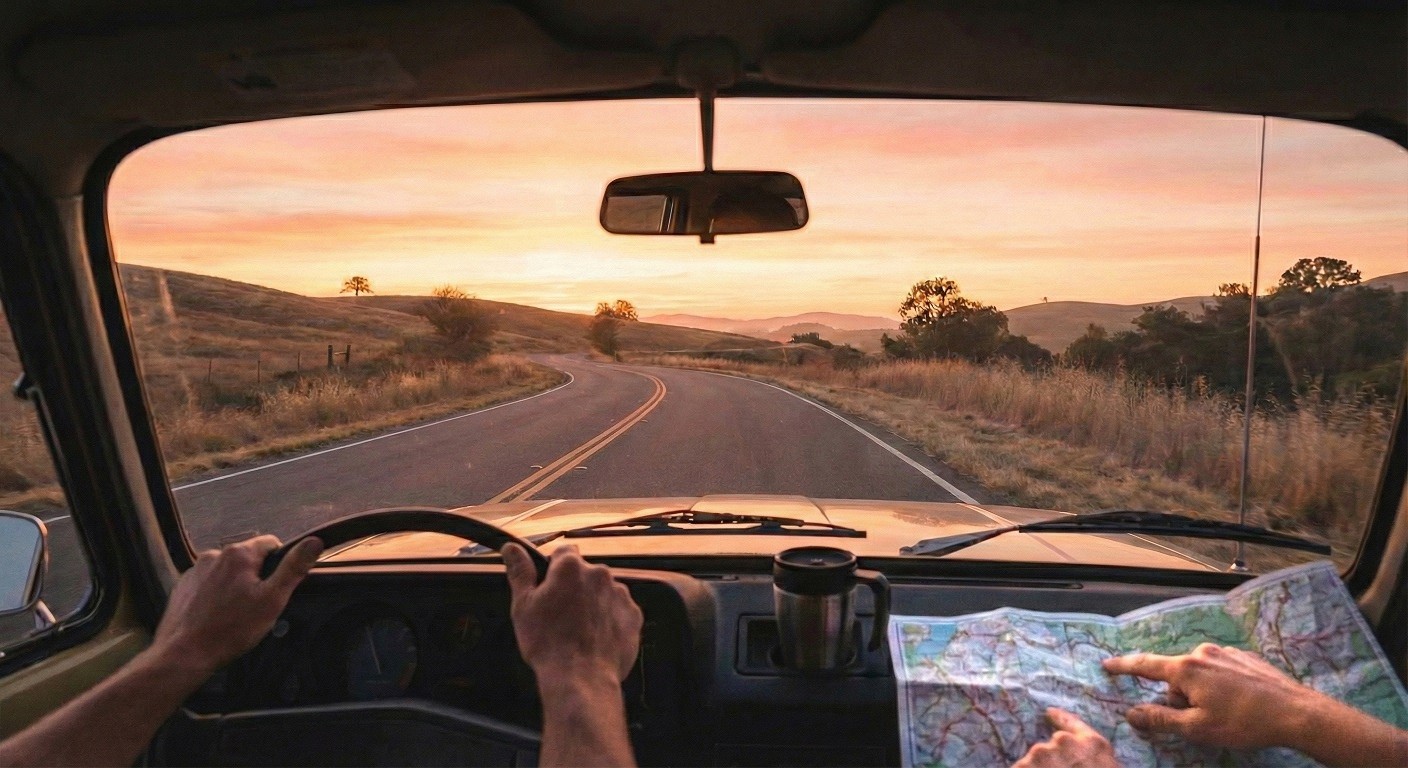
How to build a road trip budget
A road trip budget should include fuel or charging, accommodation, food, tolls, parking, activities and vehicle costs, plus a separate reserve. Estimate your complete route, including local driving and the return journey. Then price each category for your actual travellers, dates and vehicle before deciding how far to go.
Start with the money available and the experience you want. If the total does not fit, change the route, duration or paid extras before cutting safe rest and vehicle preparation.
Count more than fuel and a bed
Fuel is the obvious cost. It is rarely the only one. A road trip also comes with parking machines, toll roads and a remarkable number of opportunities to buy a sandwich you did not particularly want.
| Category | What belongs in it |
|---|---|
| Fuel or charging | The full route, local journeys, detours and realistic consumption |
| Accommodation | All nights, required charges and any parking or campsite fees |
| Food and drinks | All travellers, all days, including travel-day meals |
| Road and parking costs | Tolls, road permits where required, ferries and parking |
| Activities | Admission, tours, reservations and planned treats |
| Vehicle costs | Rental charges or relevant preparation and wear on your own car |
| Trip preparation | Required documents, suitable cover and connectivity |
| Separate reserve | Disruption costs outside ordinary spending |
Keep paid already and still due alongside each planned amount. A deposit is part of the total, not a discount. Likewise, a refundable card hold is not necessarily a final expense, but it can tie up funds you need.
The Budget Travel Checklist provides a broader final check before you book.
Calculate fuel costs in miles or kilometres
Use the vehicle’s realistic consumption for the kind of driving you expect. Include the return journey unless it is a one-way trip, along with sightseeing miles and useful detours. A map’s direct route is a starting point rather than a complete holiday.
Using miles per US gallon
Fuel cost = total miles ÷ expected mpg × price per US gallon.
For example, 1,000 miles ÷ 30 mpg × $3.60 per gallon = $120. These are invented inputs to demonstrate the calculation. Do not mix US and imperial gallons.
Using litres per 100 kilometres
Fuel cost = total kilometres ÷ 100 × litres per 100 km × price per litre.
For a separate example, 1,600 km ÷ 100 × 7.5 L/100 km × $1.60 per litre = $192. This is a different hypothetical journey, not a conversion of the first example.
Use recent prices for your actual route and test a less favourable consumption or price assumption. Hills, traffic, weather and load can change the result. Update your estimate after the first few fills if actual spending differs.
If you are taking an electric car
Estimate charging from your route, your vehicle’s likely energy use and the tariffs of the chargers you expect to use. Check the operator’s current pricing structure rather than assuming every stop charges by the same unit.
A basic energy estimate is distance ÷ 100 × expected kWh per 100 km. Multiply the energy bought at each charging price by that price, allowing for charging losses and any other applicable charges. It is a planning estimate, not a guaranteed bill.
- Check compatible connectors, access and payment arrangements.
- Allow time for charging and a workable alternative stop.
- Check parking, idle or session charges where applicable.
- Confirm whether accommodation charging is available, reserved and included or separately priced.
For a rental EV, check the return-charge requirement and any fees. An attractive daily rate does not tell you what the whole rental will cost.
A seven-day road trip budget example
This example is for two adults, seven days, six nights and 1,000 miles in their own car. All amounts are invented US-dollar planning figures. They are not typical prices, a live offer or a claim that this budget suits every destination.
| Expense | Planning amount |
|---|---|
| Fuel: 1,000 miles ÷ 30 mpg × $3.60 | $120 |
| Accommodation: 6 nights × $110 | $660 |
| Food: 7 days × $60 for both people | $420 |
| Tolls and parking | $100 |
| Activities | $100 |
| Selected trip preparation | $60 |
| Separate disruption reserve | $200 |
| Complete planned total | $1,660 |
That is $830 per person when shared equally. However, the fuel and room costs are shared, while food and admission often rise with each extra traveller. Do not simply divide a solo budget by the number of seats.
The example excludes rental, depreciation and any major servicing or repair. Add the costs relevant to your own comparison, including flights to the starting point if needed. If you are comparing driving with flying or rail, use the same cost scope for each option.
Your own car or a rental: compare the full cost
For your own vehicle, separate immediate trip spending from longer-term ownership costs. Fuel is cash leaving now; extra mileage also contributes to servicing, tyres and depreciation. You may not pay for those during the trip, but they still matter when comparing options.
For a rental, read the complete quote and terms. Check:
- Rental days and return time, including any late-return rules.
- Included mileage and excess-mileage charges.
- Additional-driver, age-related and one-way charges where applicable.
- Fuel or charging return requirements.
- Permitted routes, borders and vehicle-use restrictions.
- What cover is included, exclusions and any excess or deductible.
- Deposits, card requirements and toll-payment administration.
A smaller vehicle may cost less to hire and run, but only if it fits your passengers, luggage and route. Choose enough space and suitable capability; do not turn a saving into seven days of negotiating with a suitcase.
Separate driving days from exploring days
The original idea still earns its place: do not try to cover a long distance, visit three attractions and find dinner from scratch every day.
| Driving day | Exploring day |
|---|---|
| A realistic route with rest and meal stops | A smaller area with fewer miles |
| Arrival and accommodation access planned | Time for local sights, groceries and laundry |
| Simple food options and a flexible arrival margin | A chosen experience with spending planned |
| Driving shortened or stopped if conditions require it | The next journey checked while you have time |
You do not need a rigid alternating pattern. Adapt the rhythm to your route and the people travelling. Also, an extra exploring day adds a night and another day’s expenses; it only saves money overall if the full revised plan costs less.
Avoid a universal daily mileage target. Road conditions, weather, stops and driver capacity matter more than an impressive number on a map. Budget for enough rest, and stop somewhere safe if you become drowsy. The NHTSA road-trip checklist covers vehicle preparation and safe travel planning.
Save fuel without cutting essentials
Start with fewer unnecessary miles and sensible driving. FuelEconomy.gov’s driving guidance explains that aggressive acceleration and braking waste fuel, while roof cargo can increase aerodynamic drag.
- Drive smoothly and follow speed limits. Do not rush to recover time lost earlier.
- Check tyre pressure correctly. Follow the vehicle manufacturer’s recommended pressure and instructions. NHTSA recommends checking when tyres are cold; do not use the tyre sidewall maximum as your target.
- Remove unnecessary weight. Keep essential safety equipment, water and supplies suited to your route.
- Review detours. A drive to a cheaper fuel station can consume the saving. Consider the extra distance and time.
- Prepare the vehicle. Address maintenance needs before departure rather than gambling on the warning light developing a better attitude.
For tyre instructions, use NHTSA’s vehicle preparation advice alongside your owner’s manual. Savings should follow safe preparation, not replace it.
Plan food, nights and the costs people forget
Choose arrival times and overnight stops that leave options. Check accommodation access, parking charges and cancellation terms. For camping, check permitted sites, reservations, facilities and equipment costs. It is not automatically free or cheaper.
On food, a simple breakfast and a planned lunch can reduce repeated convenience stops. Then spend deliberately on meals you want to enjoy. Keep any perishable food at safe temperatures; a cooler is useful only when it keeps its contents properly cold.
Finally, price tolls, ferries and parking as ordinary trip expenses. Check official road or parking information for the route, including any permits or vehicle restrictions. A toll-free detour is worthwhile only when its time, fuel and other costs suit your plan.
Keep a separate reserve for plausible disruptions, such as an additional night or replacement transport. Choose an amount that reflects your route and access to help. A neat percentage is less useful than knowing what you may need to pay for.
Before you turn the key
- Map the complete journey. Include the return leg, local journeys and practical stops.
- Calculate fuel or charging. Use realistic consumption and current route prices.
- Price every night and day. Include the travellers actually going, along with road and vehicle charges.
- Protect rest and preparation. Give both space in the schedule and the budget.
- Check the total against your limit. Adjust the route, duration or extras if needed, then review spending during the trip.
Return to How to Travel Cheap for the wider strategy, use the Budget Travel Checklist before booking, and consult Travel Logistics & Transit for the connections and practical arrangements.
The point of a road trip is to enjoy what is outside the windscreen. A little planning helps keep your attention there, rather than on the bank balance.
Road trip budget questions
Calculate your route’s fuel or charging, accommodation nights, food, road charges, activities and vehicle costs, then add a separate reserve. Use current quotes for your dates. There is no universal daily amount that covers every route and traveller.
For miles and US gallons, divide total miles by expected mpg and multiply by the price per US gallon. For metric figures, divide kilometres by 100, multiply by litres per 100 km, then multiply by the price per litre.
It may cover a short trip with modest costs, but it is not a reliable answer without knowing the distance, nights, travellers and vehicle. Build the complete estimate first and shorten or simplify the trip if it exceeds the limit.
No. Compare complete costs for the same travellers and dates. Driving includes vehicle expenses and may require extra nights; flying includes baggage, transfers and onward transport. Journey time and comfort also matter.
It can reduce driving that day, but it also adds another day’s expenses and potentially another night. Compare the revised trip total. Extra time may improve the holiday even when it does not reduce the cost.
What caught your road trip budget out?
Was it the tolls, parking, a one-way rental charge or those suspiciously frequent snack stops? Share the expense you would plan for next time in the comments.
About Rob: Rob Wheatley is a former ocean Cruise Director and a Viking Program Director. His travel guidance combines professional experience with practical planning. Official guidance reviewed on 17 October 2026.