Free Spirit Travel
Free Spirit Travel Architecture
Around The World With Rob
Free Spirit Travel

MODULE 4 · PRACTICAL TRAVEL PREPARATION

Packing for 6+ Months: Minimalist Strategies That Actually Work

Long-term travel is life-changing, but packing for six months (or longer) can melt your brain. You want to feel prepared, and yet you don’t want to haul a small apartment through airports, buses, cobblestones, and stairs that somehow never end. This guide gives you a clean system: a minimalist gear list, weight-saving hacks, and a simple sentimental rulebook— so your bag feels light and your mind feels even lighter.

Last updated: · Reading time: ~12–15 min

Best for: 6–12 months Style: Carry-on / backpack Goal: ≤ 7–10 kg base weight

In a Nutshell

What this page covers

Your minimalist target

Aim for 7–10 kg (15–22 lb) base weight depending on your travel style. You’ll move faster, pay fewer baggage fees, and stop repacking your life every second day.

The rule that prevents overpacking

Don’t pack for every possible scenario. Instead, pack a flexible core and plan to buy or replace items as you go. That’s how long-term travelers stay sane.

Sentimental items (yes, you’re allowed)

Keep 1–3 tiny anchors that bring daily comfort, but never bring anything irreplaceable. You’re traveling—to feel free, not fragile.

The “wear ratio” method

Build a wardrobe around frequency: daily items, weekly items, and rare-use items. It’s the fastest way to cut your bag down without fear.

Packing, but with feelings

The sentimental item rulebook: what’s worth bringing?

Long-term travel can be emotional, and a tiny sentimental anchor can ground you—especially early on. The trick is choosing something that comforts you without turning your bag into a fragile museum.

  • Small + sturdy: if it needs a hard case or “special care,” it’s probably not the one.
  • One item, max: pick your “one anchor” and commit (you can always rotate later).
  • Travel-proof value: ask: “If this got lost… would it ruin the trip?”
  • Bonus points: doubles as something useful (scarf, bandana, charm on a zipper, photo card in wallet).

Quick filter: comfort in your pocket, not stress in your backpack.
Use the 60-second “worth bringing” test →

Why minimalism wins for long-term travel

Overpacking doesn’t just add weight—it adds friction. And friction is what quietly drains the joy from travel: slower transit, more fatigue, more “where did I put that?” moments, and a bag you start to resent. Minimalism flips that. You gain speed, comfort, and flexibility—without feeling unprepared.

Efficiency

Less stuff means less repacking, fewer lost items, and faster check-ins.

Versatility

Multi-purpose gear adapts to climates, cultures, and activities.

Freedom

The lighter you travel, the more options you have: detours, cheaper transport, fewer fees.

The minimalist gear list for 6+ months

This list is built around real-world movement: airports, buses, ferries, day hikes, city wandering, laundry days, and the occasional “why is it suddenly cold?” moment. Pack for repeatability, not novelty.

Clothing: 10–12 core items (all seasons)

  • Tops: 2 base layers (merino/technical), 3 quick-dry shirts, 1 light “nice” top
  • Bottoms: 1 travel pant (or convertible), 1 leggings, 1 shorts
  • Layers: 1 packable insulating layer, 1 lightweight rain shell
  • Extras: 1 swimsuit, 1 scarf/sarong (towel/blanket/shade/privacy hack)
  • Underwear/socks: 5–7 each (quick-dry beats “more pairs”)

If you can’t wear it at least once a week, it needs a very good reason to be in your bag.

Shoes: the category most people overpack

  • 1 closed shoe: trail runners or a comfortable sneaker that handles cities + light hikes
  • 1 open shoe: sandals for hot days, showers, beaches, relaxed walking
  • Optional (only if required): one specialty shoe tied to your actual daily life

If you’re tempted by a third pair, ask: “Will I wear this weekly—or am I packing an identity?”

Toiletries: carry-on smart, refill on the road

  • Refillable bottles (100 ml / 3.4 oz) and a tiny “leak kit” (mini zip bags)
  • Solid shampoo/soap bar (saves space and liquid rules headaches)
  • Microfiber towel (or a compact travel towel)
  • Razor, small nail clippers, minimal skincare (the “daily only” rule)

Authority reference: TSA carry-on liquid limits baseline is the 3-1-1 liquids rule.

Tech & documents: small, secure, non-negotiable

  • Universal adapter + compact multi-USB charger
  • Phone + optional lightweight laptop/tablet (based on work needs)
  • E-reader (your shoulders will thank you)
  • Digitized docs: passport, visas, insurance, emergency contacts (cloud + offline copy)

Authority reference: align your document prep with official guidance; see the U.S. State Department travel info here.

Weight-saving hacks you’ll wish you knew sooner

The goal isn’t suffering. It’s leverage. Small choices compound into a bag that feels effortless instead of punishing.

Use compression (but don’t lie to yourself)

Compression sacks save space, not weight—great for organization, dangerous for “extra stuff.”

Layer instead of packing bulk

Thermals + midlayer + shell beats one huge coat and adapts to changing weather fast.

Wear heavy items on travel days

Your heaviest shoes and jacket belong on your body when you move.

Stop packing duplicates

Two “just in case” versions of the same thing quietly murder your bag.

Build a laundry rhythm

Sink-wash + a tiny clothesline = fewer clothes overall. It’s glamorous. Sort of.

Go ultralight where it matters

Focus on big hitters: bag, shoes, outer layers, tech. The rest is marginal gains.

A rule that prevents “just in case” packing

If it solves a problem that can be fixed with money (buy it) or time (rent it, borrow it, improvise), don’t pack it. Save your space for genuine daily needs.

The sentimental item rulebook: what’s worth bringing?

Long-term travel can be emotional, and a tiny sentimental anchor can ground you—especially early on. The trick is choosing items that comfort you without turning your bag into a fragile museum.

The 3-question filter

  1. Is it functional? A journal beats a photo album.
  2. Does it create daily joy? Keep it to 1–3 small anchors.
  3. Can it be replaced if lost? Never bring irreplaceable heirlooms.

Smart examples

  • A bracelet or necklace (wear it—zero bag space)
  • A pocket notebook (daily grounding + memories)
  • A small printed photo (flat, light, replaceable)

Sentimental items should feel like comfort, not responsibility. If losing it would ruin your trip, it stays home.

The 60-second “worth bringing?” test

This is the quick gut-check. Answer fast. The aim is comfort—without turning your backpack into a high-maintenance museum exhibit.

Packing, but with feelings

The 60-second “worth bringing” test

Hold the item. Answer fast. No spiralling. You’re aiming for comfort — not a fragile museum exhibit.

6 questions ~60 seconds Result + next step
Ready when you are.

Note: This is guidance, not law. If an item is irreplaceable or financially valuable, this quiz will almost always steer you toward a safer alternative.

Systems seasoned long-term travelers actually use

The secret isn’t a perfect packing list. It’s a repeatable process. When your system is good, your bag stays good.

Monthly reset

Every 30 days: remove one unused item, replace one worn item, adjust for the next climate shift.

Buy-as-you-go mindset

Start with 70% of your ideal kit, then upgrade locally as real needs show up.

The “wear ratio” audit

If something isn’t worn weekly, it needs a job—or it needs to go.

Charts & visuals you can use (and a few you should create)

These visuals make the guide easier to follow and keep readers on the page longer. Keep image text minimal, and put the explanation in captions and body copy (for SEO).

Backpack base-weight targets (quick table)

Travel style Ideal base weight Why it works
Carry-on only 6–7 kg (13–15 lb) Fast transit + fewer fees
Backpack + personal item 8–10 kg (18–22 lb) More flexibility, still mobile
Checked bag traveler 12–15 kg (26–33 lb) Comfort, but higher friction

“Base weight” = bag + contents (excluding water and worn clothing).

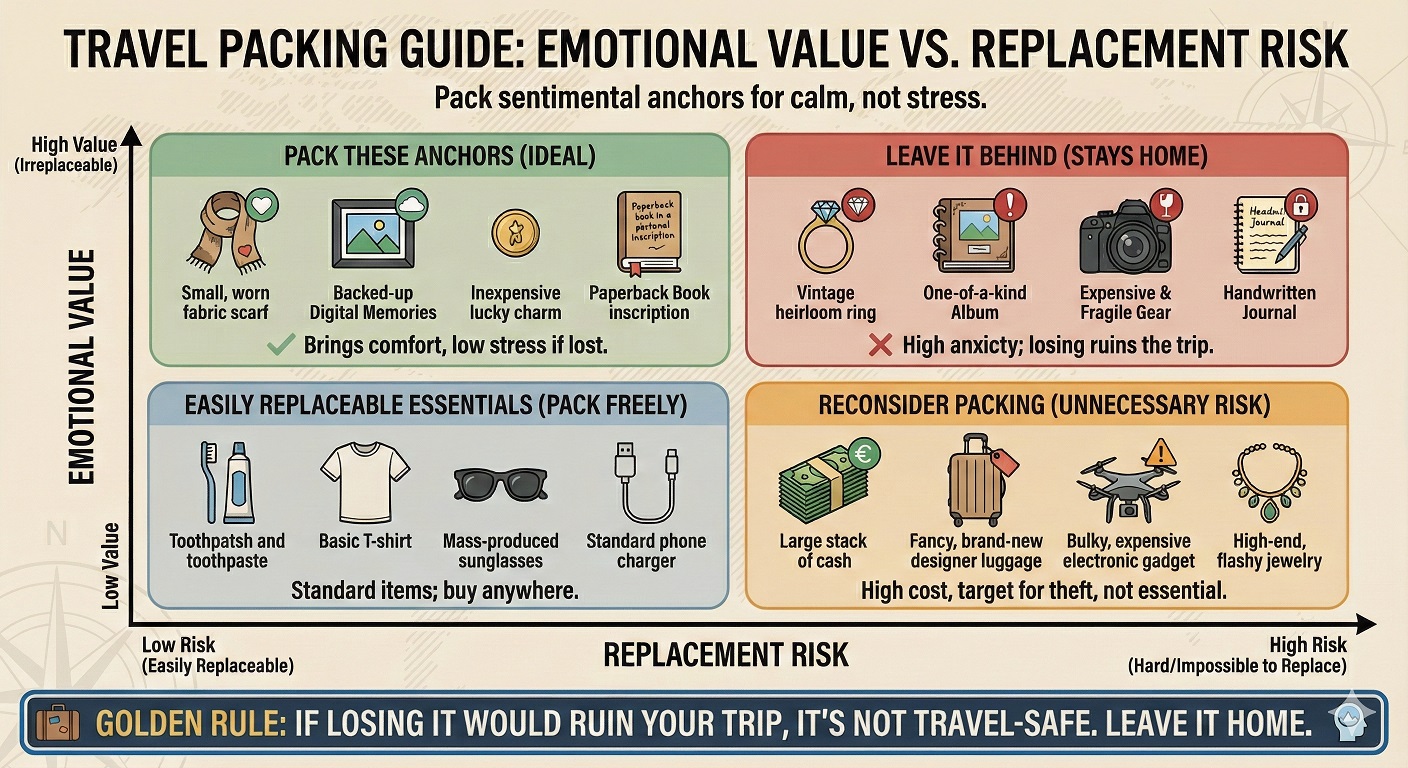
Visual: Emotional value vs replacement risk

Pack sentimental anchors that bring calm, not stress. If losing it would ruin your trip, it’s not travel-safe.

Travel packing guide graphic: emotional value vs replacement risk
Decision lens: high comfort + low replacement risk is ideal. Irreplaceable items stay home.

Downloads & FAQ

A quick toolkit for the practical stuff—plus answers to the questions that derail packing plans at midnight.

FAQ: Packing for long-term travel

How heavy should my backpack be for 6+ months of travel?

A strong target is 6–7 kg (13–15 lb) if you’re trying for carry-on-only, and 8–10 kg (18–22 lb) if you need a bit more flexibility. If your bag feels “fine” in your bedroom but brutal after 30 minutes walking, it’s too heavy.

What’s the biggest mistake people make when packing for long trips?

Packing for every imagined scenario. Long-term travel rewards adaptability. Pack a repeatable core kit, then buy/replace items on the road as real needs show up.

Can I bring sentimental items while traveling long-term?

Yes—keep it small and travel-safe. Choose items that provide daily comfort but aren’t irreplaceable, like a wearable keepsake, a pocket journal, or a small printed photo.

NEXT UP

Documents, Visas & Travel Documentation

Packing light is step one. Step two is making sure you can actually enter the countries you’re dreaming about. Next up: passports, visa timelines, proof-of-onward travel, digital backups, and the “don’t get stuck at check-in” checklist.

Join the conversation

What’s your go-to packing hack—and what’s the one thing you always regret bringing? Drop it in the comments. Your tip might save another traveler’s shoulders (and sanity).