- 1
- 2
- 3
- 4
- 5
- 6
- 7
- 8

MODULE 7 · CULTURAL IMMERSION
Cultural Immersion & Regional Exploration
This is where travel stops being “places” and becomes “people.” We’ll cover etiquette, language, affordable local food, and how to use food as a bridge — so you explore regions in a way that feels respectful, confident, and genuinely memorable.
Not “pretend you’re a local.” More like: show up well, learn fast, spend your money where it helps, and build real human moments — without turning it into a performance.
MODULE OVERVIEW
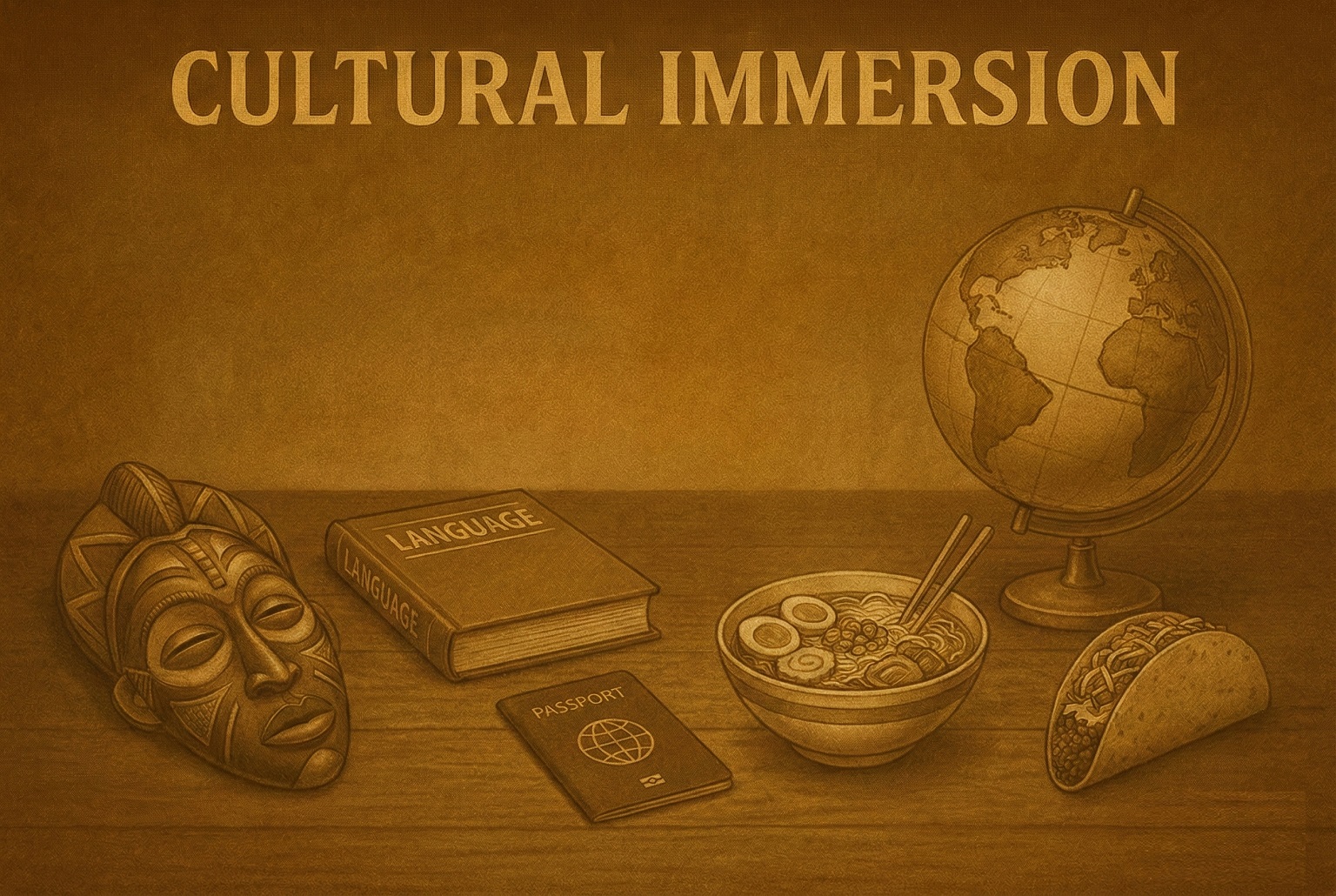
A Quick Visual Of What You’re Building
Respect is a skill set. This module gives you simple systems — etiquette, language, and food — so you travel deeper without turning it into a performance.
How to use this module (so it actually helps)
Cultural immersion isn’t about “doing everything right.” It’s about doing a few things consistently that show respect quickly.
Etiquette first
Learn the few “big rules” before you arrive — it prevents 80% of awkward moments.
Language second
Build a minimum kit you’ll actually use: greetings, thank you, numbers, help, food basics.
Food as your bridge
Use simple rules to eat locally on a budget — then use food to connect, not just consume.
Fast track (busy week): Do Lesson 1 (etiquette) + Lesson 2 (language). Those two unlock most of the “travel deeper” feeling without extra homework.
What This Module Covers
By the end of this module, you’ll be able to…
- Understand etiquette basics that prevent awkward moments fast.
- Use a simple language system that sticks under travel stress.
- Eat locally on a budget — with safer decision rules.
- Use food as a bridge to better conversations and deeper travel days.
Common traps (and the simple fix)
- Trap: Overthinking etiquette until you freeze.
Fix: Learn the 5 big rules, then act kindly. - Trap: “Immersion means I must do everything locals do.”
Fix: Aim for respect, not cosplay. - Trap: Paying extra for “authentic.”
Fix: Markets + neighborhood places beat paid performances. - Trap: Treating food like a checklist.
Fix: Ask one good question, learn one story, and slow down.
The simple way to use this module
- Learn etiquette basics before arrival.
- Build your “minimum viable vocabulary.”
- Use the food system for safer, cheaper local meals.
- Use food to connect with people (without being weird about it).
Lessons in this module
Short, practical, and built for real travel days — not perfect-study fantasies.
LESSON 1
~18 minCultural Etiquette: Respectful Behavior & Customs
The unwritten rules that help you avoid awkward moments and show respect quickly.
LESSON 2
~16 minLanguage Learning Tips for Travelers
Simple systems to learn what matters — so you communicate with confidence even as a beginner.
LESSON 3
~15 minExploring Local Cuisine Affordably
Markets, street food, and smart ordering — eat like a legend without rolling the dice.
LESSON 4
~14 minDeepening Connections Through Food
How to turn a meal into a shared moment — without forcing it or overthinking the vibe.
Downloads & tools
Optional, but useful. If you like having a small system in your pocket, these help.
Download packPrintable PDFs and templates
Quick promptsShort, not workbook-y
- What’s one local habit I can adopt that shows respect immediately?
- What’s my “minimum language kit” for this place?
- What’s the simplest “safe local food rule” I can follow today?
- What’s one question I can ask at a meal that invites a real answer?
Finish Module 7 first
This course is designed as a sequence. Module 8 becomes available inside the final Module 7 lesson once you’ve completed the core steps above.
Join the conversation
What’s one cultural habit you learned while traveling that instantly changed how locals treated you? A greeting, a table rule, a small courtesy — share it below. Someone reading this is about to walk into that exact moment.