Slovakia · Destination guide
Bratislava: Castle Views, Coronation Streets and a Man in a Manhole
Bratislava strikes me as a capital with a sensible sense of scale. The old centre is manageable, the castle supplies the view, and a bronze man spends his working day looking out of a drain. Austria and Hungary are the neighbours; Slovakia has kept the coronation streets and a pleasingly individual sense of humour.
I’d begin in the old town, then decide whether the castle climb or the Blue Church gets the extra time. Leave room for a café. A small centre deserves a slower pace, not a shorter visit.
By Rob Wheatley · Traveller and Viking Program Director
Explore the Slovakia destination guide →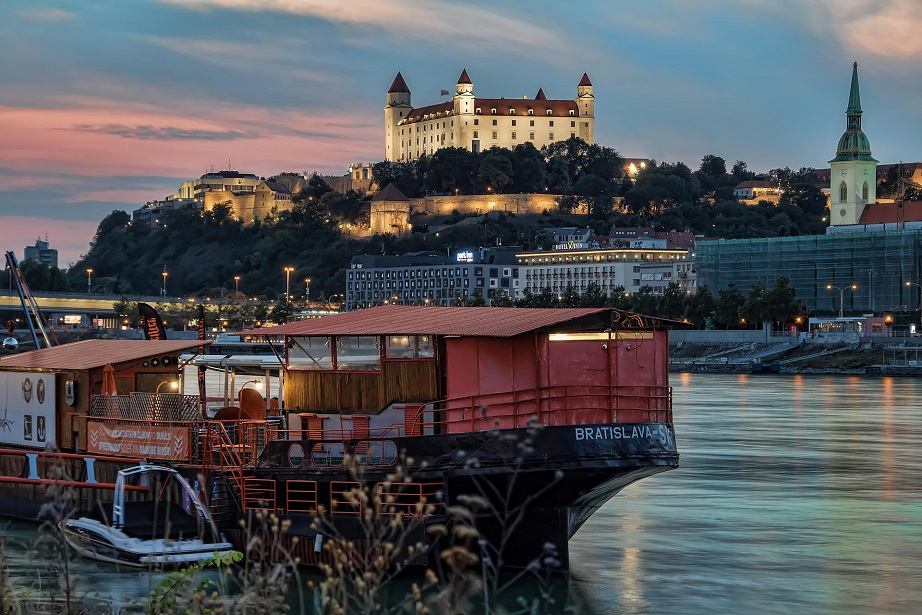
Bratislava at a glance
- My priority
- The old town and St. Martin’s Cathedral, with the castle viewpoint if time and mobility allow.
- If time is short
- Enjoy the centre properly. Choose one extra: the castle hill or the Blue Church.
- Walking and access
- Historic paving in the centre; slopes and possible stairs on castle approaches. Confirm an accessible route before committing.
- A useful pause
- Coffee and a Bratislavský rožok, the local crescent pastry with walnut or poppyseed filling.
The small capital that carried a kingdom’s crown
For almost three centuries, from 1563 to 1830, Hungarian rulers came to Bratislava to be crowned. The city, then known in German as Pressburg and in Hungarian as Pozsony, had become the kingdom’s capital in 1536. Those are two different milestones, although they often get squeezed into the same sentence.
Maria Theresa received the Hungarian crown in St. Martin’s Cathedral on 25 June 1741. Think of the processions moving through these streets: court officials, churchmen, royal ceremony and a city temporarily carrying the ceremonial heart of a kingdom. A crown on the cathedral tower still points to that past.
There is another dramatic moment from that year, but it belongs to a different occasion. In September, Maria Theresa appealed to the Hungarian Diet for support; the nobles pledged their lives and blood. It makes a splendid story without attaching the response to the wrong procession.
I’d look at the cathedral before climbing to the castle. The view is better when you have some idea what the buildings below you have been through.
The castle: earn the view, choose the visit
The white, four-towered castle gives Bratislava its unmistakable skyline. From below, it seems to supervise the river. From the hill, the relationship between the Danube, the old town and the neighbouring countries becomes easier to understand.
A walk to the grounds and viewpoints is a different commitment from a museum visit inside. Check current opening arrangements and admission details before building your day around the interiors. If you have only a few hours, I’d choose deliberately rather than arrive at the ticket desk with a departure time already breathing down my neck.
The climb is a real consideration. Ask about slopes, steps and transport options for your particular starting point. An old town can look wonderfully compact on a map while the castle quietly adds the vertical part.
Čumil: the man who looks up from the sewer
Bratislava’s streets are decorated with statues of everyday people. A man peeks out of a manhole, a soldier leans on a bench, and nobody finds it strange. Čumil is the one who brings pedestrians to a halt.
Created by Viktor Hulík in 1997, the bronze worker rests his chin above the pavement, apparently content to watch the city go by. He is a modern addition to the old town, not a medieval character who has somehow survived underground.
The tourist board repeats the local good-luck legend: touch the button on his cap. That is folklore rather than a guarantee, although the polished bronze suggests plenty of people are prepared to give it a try. Its Slovak-language account also records two accidents and an attempted theft. I’d leave the more elaborate stories about drunken drivers and the sculptor’s intentions with the people telling them.
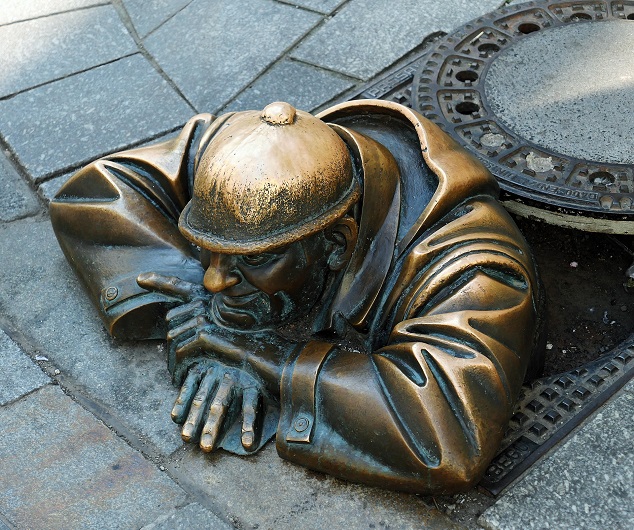
Take your photograph, then give somebody else a turn. He may have all day; the queue behind you probably hasn’t.
The Blue Church: an ambitious pastry chef’s idea of architecture
A blue church that looks like it was baked by a very ambitious pastry chef. That is the immediate impression; the details reward staying a little longer.
Its formal name is the Church of St. Elizabeth of Hungary. Designed by Edmund Lechner and consecrated in 1913, it is an Art Nouveau building associated with the Hungarian Secession style. Pale-blue walls, glazed ceramics and the round tower give it a very different character from the coronation cathedral.
It sits beyond the tightest old-town circuit on Bezručova Street. Allow a separate walk rather than assume it will appear beside the main square. Check the parish’s current visiting arrangements if seeing the interior matters, and remember that services take priority over sightseeing.
A sensible half-day in Bratislava
My starting point would be St. Martin’s Cathedral and the old-town streets around the main square, with Čumil along the way. Then choose the castle hill for the outlook or the Blue Church for the architecture. With a full day, both become easier to fit around lunch and an interior visit.
Keep some time for simply sitting down. The local Bratislavský rožok comes with walnut or poppyseed filling, and is an excellent argument against treating every café as an interruption to sightseeing.
Independent visitors should check their arrival point against the actual route into the centre. Rail stations, bus stops and river berths are different starting places. For access needs, use the tourist board’s current accessibility information rather than assume a pedestrian area means an entirely level one.
Stay for the evening as well
How long: A full day covers the old town, castle area and Blue Church at a sensible pace. An overnight buys dinner and a quieter wander. Rail stations, bus arrivals and river landings are in different places; check the last leg to your accommodation through Visit Bratislava.
When: My pick is late spring or September for walking. Summer suits evening terraces but can make the castle hill hot. Winter brings shorter days; market dates and attraction access need a deliberate check rather than an assumption.
Try: Bryndzové halušky—potato dumplings with sheep’s cheese, often topped with bacon—is a filling Slovak introduction. The tourist board’s food guide also gives seasonal options. That is a lunch to enjoy, not necessarily the ideal preparation for racing uphill.
For river cruise guests
Visiting with Viking?
Included programme: Viking’s published 2027 Danube Waltz itinerary lists a Bratislava Walking Tour. It is a useful introduction to the centre; check your sailing’s description for the exact route and walking demands.
Optional, at additional cost: the published programme also lists a Bratislava Hike and excursions farther afield, including Red Stone Castle & Wine Tasting. Availability varies. A castle photograph on an itinerary page does not mean a castle interior visit is included in the walking tour.
Before exploring independently, confirm your berth, all-aboard time and any ship movements. Work from the daily programme when deciding whether there is time for the castle hill or Blue Church after the included tour.
Checked against Viking’s published 2027 Passau–Budapest programme on 7 November 2026. Your booked sailing confirms timings, prices and inclusions. I work for Viking; this is my own practical guidance.
Explore the Danube Waltz itinerary →Explore more along the Danube
Planning sources
History and visitor information checked 7 November 2026. The tourist board’s pages differ on the total number of coronations; this guide uses the consistent dates and named events. Check opening times and your own sailing before travelling.
What caught your eye in Bratislava?
The castle view, a coronation detail or the man in the manhole? Share the place you would send another traveller, or ask a planning question.
Join the conversation below ↓