Wittenberg: A Monk, a Church Door and Time for Cake
I like a town that makes sightseeing straightforward. Luther’s house at one end, the famous church door at the other, and somewhere for coffee in between. Wittenberg has arranged five hundred years of history with considerable thought for my attention span.
By Rob Wheatley · Explore my Germany guides
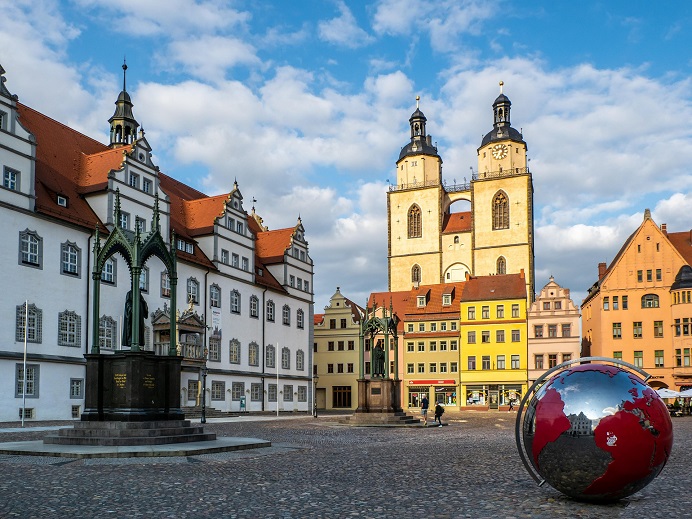
Twenty minutes to walk it. Rather longer to take it in.
You can walk between the two in about twenty minutes. Understanding what happened here takes rather longer. A monk challenged the religious establishment, his arguments helped ignite the Protestant Reformation, and Europe spent centuries dealing with the consequences. I’ve had disagreements that spoiled a dinner. Luther’s went somewhat further.
What appeals to me is the contrast. You’re walking through a place associated with enormous upheaval, yet there are pastel houses, quiet courtyards and people getting on with their day. History can make somewhere sound terribly intimidating. Then you arrive and somebody cycles past with their shopping.
Wittenberg at a glance
- The straightforward route
- Lutherhaus and the Augusteum → Collegienstraße → market square and St Mary’s → Schlossstraße → Castle Church. Roughly twenty minutes of walking, before visits and diversions.
- The famous door
- At the Castle Church, not the twin-towered church beside the market square. The bronze replacement dates from 1858.
- Important museum update
- Lutherhaus is closed for renovation, with reopening expected in 2027. The neighbouring Augusteum is open with a Luther exhibition.
- My approach
- Allow an afternoon rather than treating the short walk as the whole visit. Leave room for courtyards, a church interior and something involving cake.
The door needs a little explanation
At the Castle Church, I think the famous door needs a little explanation. The original is gone, and the story of Luther hammering up his Ninety-Five Theses is a tradition rather than an established eyewitness account. The replacement bears the theses in bronze. Knowing that doesn’t spoil it for me. The significance is in the ideas, although I admit a monk with a hammer makes a better opening scene.
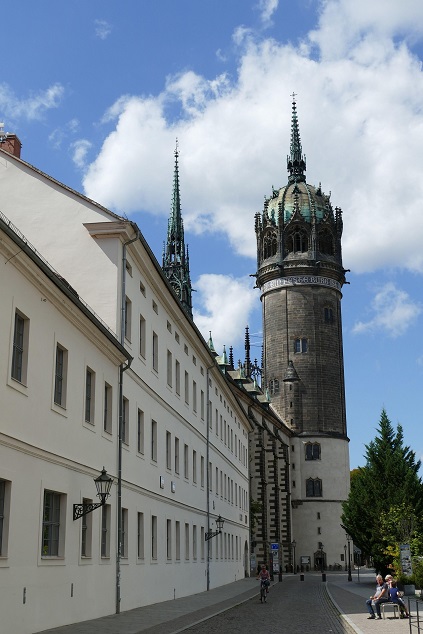
The traditional date is 31 October 1517. In his theses, Luther challenged abuses surrounding indulgences and invited scholarly debate. The wooden door was destroyed in a fire in 1760; the bronze doors you see today were donated by Prussia’s Frederick William IV in 1858.
I’d take a moment with that distinction. You are looking at a memorial to a moment, rather than the original piece of wood. The history is quite large enough without asking the door to have survived everything as well.
The Castle Church remains a place of worship. Check its official visitor information for opening arrangements, services and tickets; don’t assume the church, a guided visit and the tower all have the same access conditions.
Luther gets the billing. Melanchthon deserves a look.
Luther is everywhere, naturally. His name is even part of the town’s official name: Lutherstadt Wittenberg. After a while, you begin to wonder whether Melanchthon ever fancied having a quiet word about the publicity arrangements.
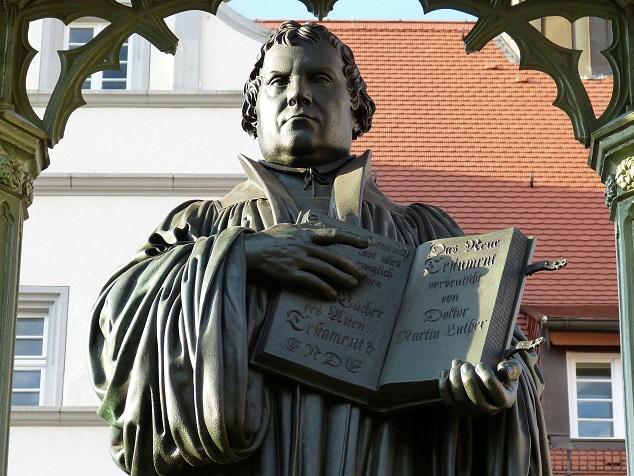
Lutherhaus was his home and workplace, first as part of an Augustinian monastery and later as a family household. It gives the story a human address: this wasn’t simply a man producing arguments in a historical vacuum. There was a home, a family and a working life around it.
Plan around the closure: Lutherhaus itself is currently shut for renovation. The museum foundation expects it to reopen in 2027. In the meantime, the Augusteum next door hosts Literally Luther. Facets of a Reformer. Check the foundation’s current details before booking or setting off.
The Melanchthon House is another option if you want to broaden the visit beyond Luther. For my money, a town becomes more interesting once you get past the one name everybody arrived knowing.
Leave some room for the town
But I wouldn’t rush through collecting Luther landmarks. I’d look into the courtyards, linger in the market square and leave room for cake. There’s something rather pleasing about giving a place that changed European history an afternoon of your time—and discovering that you enjoy its quieter details just as much.
At the market square, the twin towers belong to St Mary’s Town Church, a separate stop from the Castle Church. Inside is the Reformation altarpiece associated with Lucas Cranach the Elder and Younger. If the church is open, it offers a different way into the story: through images rather than another set of dates.
The Cranach courtyards are worth considering too. They connect the town with the artistic family whose work helped give the Reformation its familiar faces. I like that reminder that ideas need people to put them into words, pictures and print. They don’t spread themselves.
My suggestion is simple: walk the main route, choose the interiors that interest you, then stop trying to be efficient. Comfortable shoes help on the cobbles, and a short distance on a map doesn’t account for standing during a guided visit.
Twenty minutes to walk it. I’d allow considerably longer.
Especially if the cake looks good.
Wittenberg without the excursion timetable
How long: Give the town a full day for the main walk and two interiors, or an overnight if you want a quieter evening. The twenty-minute walk in the opening is the direct route, not the time required to enjoy the place.
Arrival: Rail makes a day trip worth considering from Berlin or Leipzig. The main station and Lutherstadt Wittenberg Altstadt are different stops; choose according to your actual service and route. The tourist office puts the walk from Hauptbahnhof to the Lutherhaus area at roughly fifteen minutes.
When and food: My preference is a mild weekday in spring or early autumn. Check events around Reformation Day on 31 October if you want either atmosphere or a quieter visit. A bakery lunch or coffee and cake fits the pace; a fabricated must-eat local speciality would add less than choosing somewhere you actually want to sit.
Wittenberg on Viking’s Elegant Elbe
Viking lists an included Wittenberg Walking Tour on Elegant Elbe. I suggest taking that introduction: the town is compact, but the connections between the buildings make far more sense when somebody joins them up.
Then use any free time for what caught your attention, whether that means another interior or a quieter look at the town. Museum entry and independent visits should be checked against your actual excursion description; don’t assume that every place in this guide is included.
Viking also lists Leipzig & Bach as another excursion option on the published Wittenberg day. Availability and timing depend on your sailing. Check My Viking Journey and the onboard programme before making plans around either.
On the Berlin-to-Prague itinerary, Wittenberg follows the Potsdam transfer and embarkation. In the opposite direction it comes towards the end of the river journey. Confirm your ship’s location and return time before wandering off independently.
Visitor information checked 8 November 2026. Openings and cruise excursions may change. Sources: Castle Church: the Theses Door; LutherMuseen: Lutherhaus and Augusteum; Wittenberg tourism: St Mary’s; Wittenberg tourism; Viking: Wittenberg excursions.
Back to top ↑
What stayed with you in Wittenberg?
The church door, the quieter courtyards or a particularly persuasive piece of cake? I’d like to hear.
Share your Wittenberg thoughts ↓