BULGARIA • SLOW TRAVEL • CITY STORIES
Plovdiv: The City That Never Needed to Shout
Roman stones, strong coffee and the fine art of getting pleasantly lost.
By Rob Wheatley – Program Director & traveler
First published 15 April 2015 · Research checked 20 October 2026
Plovdiv, Bulgaria, rewards slow wandering: Roman ruins beneath the shopping streets, colourful Old Town houses above them, and Kapana’s cafés waiting below. This is my story of getting pleasantly lost, with practical notes on the theatre, local food and planning a visit without turning the whole thing into a timetable.
Planning beyond this visit? Then use my Bulgaria travel guide to choose your next stops and build a journey that fits your time.
“Where am I?”
The sign above the café is written in letters I almost recognise. Some look like old friends; others look like they’ve been hit by a bus. I can’t read a single word. When I ask for a coffee, the waiter nods his head, which I’m fairly sure means no. Then he walks off and returns with a coffee anyway.
I’ve just lost an argument with a city, and I haven’t even sat down.
Beneath my feet, through a glass panel set into the pavement, lie the stones of a Roman stadium. Nobody walking past is looking at them. They’ve got places to be.
That’s the first thing you learn in Plovdiv. This is one of Europe’s oldest continuously inhabited cities, with a history stretching back more than 6,000 years. It has been Thracian, Roman, Byzantine, Ottoman and Bulgarian, and it has the unbothered air of someone who has seen every fashion come and go. You’ll be sipping a cappuccino on top of an empire, while the locals simply wonder why you’re staring at the ground.
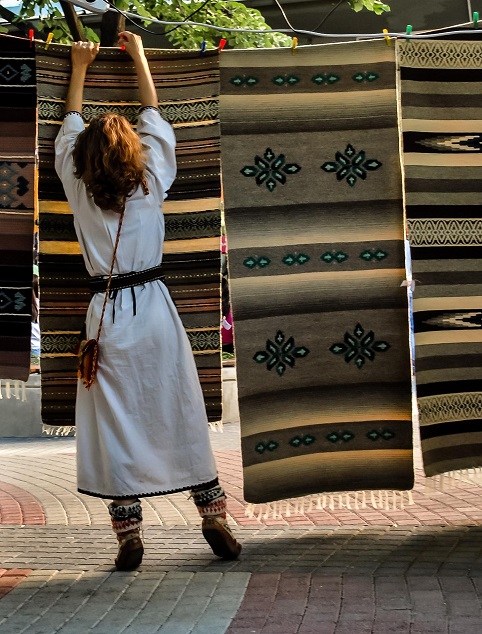
Lost in translation, found in a café
After years of cruise ships, polished promenades and destinations that know exactly what a tourist wants, Plovdiv is a gentle shock. Nothing here is performing for me. The menu in front of me isn’t translated, the pace is slow, and the old men in the park are far more interested in their chess game than in me.
So I do what I’ve learned to do when I’m out of my depth: I stop pretending I’m not. First, I point. Then I smile. In Bulgaria, a nod can mean no and a shake of the head can mean yes, although habits vary and people may adapt for visitors. Saying da for yes or ne for no is a better plan than interpreting neck movements.
Meanwhile, I make a private vow to stop agreeing to things by accident. I’m not confident I’ll keep it.
By the second coffee, I’ve decided that being slightly lost is the whole point. This is the pleasure of slow travel: giving a place time to become more than a photograph.
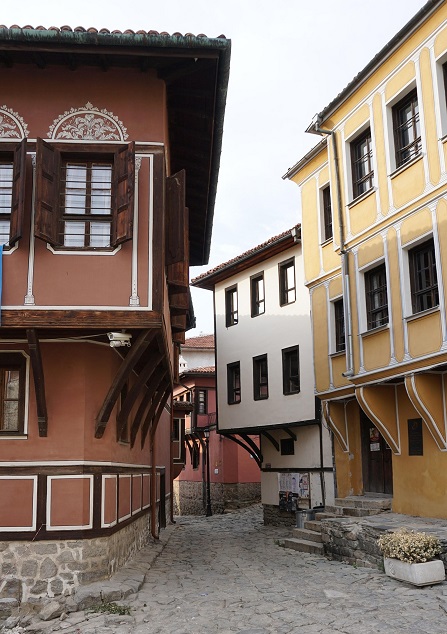
Climbing into Plovdiv’s Old Town
Plovdiv is built across hills, and the Old Town sits on some of its most atmospheric slopes. The cobbles are steep, uneven and polished smooth by centuries of feet, so wear shoes you trust.
Then the lanes open up and you’re walking between National Revival houses in deep reds, mustard yellows and blues. Their upper floors lean out over the street as if they’re eavesdropping.
Step inside the Balabanov House or the Hindliyan House and you find carved ceilings, painted walls and rooms made to impress. The Balabanov House is a reconstruction of a nineteenth-century home; Hindliyan preserves the atmosphere of a wealthy merchant’s residence.
It feels like a film set. Yet this is a living neighbourhood, with ordinary life continuing between the museums.
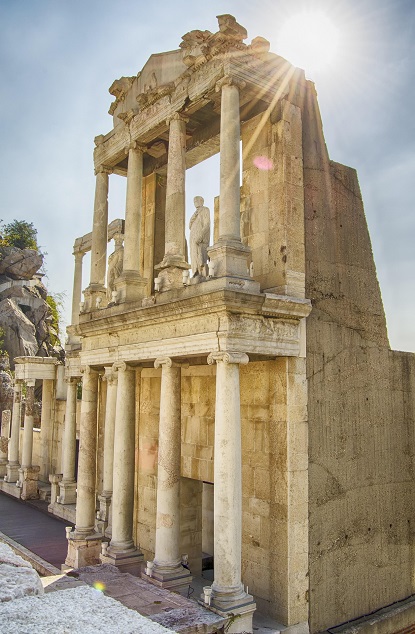
The best seat in town: the Roman Theatre
And then there’s the Roman Theatre.
Its story has acquired a useful correction. Although older accounts often place it under Trajan, Plovdiv’s official tourism information now points to an inscription dating the theatre to the 90s of the first century AD.
Archaeologists uncovered it in the twentieth century, and restoration brought its sweeping tiers back into use. Today it still hosts opera, concerts and other performances. Nearly 2,000 years after the Romans, people are still finding their seats.
I take a seat in the restored theatre and look across the rooftops to the mountains beyond. As the afternoon light turns the city gold, the usual urge to move on quietly disappears.
I’ve stood in some of the world’s great places. Few have made me want to sit still quite so happily. On my visit, there was no queue hurrying me along; that is a memory, rather than a promise about your afternoon.
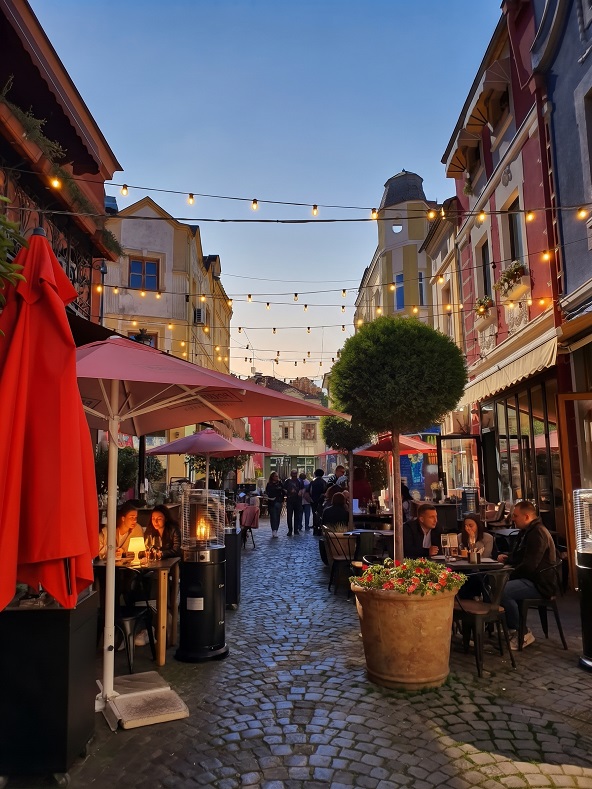
Kapana: the trap that wants you to stay
Back down the hill, the city changes personality completely.
Kapana means “The Trap”, and it’s the best-named neighbourhood I’ve come across. A maze of lanes leads past street art, craft shops, independent cafés and bars. It’s very easy to wander in for ten minutes and surface three hours later holding a handmade something you didn’t know you wanted.
Plovdiv was a European Capital of Culture in 2019, alongside Matera in Italy. In Kapana, that creative energy feels less like an anniversary and more like a daily habit.
The Old Town is the history. Meanwhile, Kapana is proof that the city is still writing new chapters.
Dinner, and the rakia that arrives uninvited
Evening is for eating. Banitsa, a flaky pastry often filled with cheese, is breakfast, snack and comfort all in one. Then there’s shopska salad, piled with tomato and crowned with white cheese, smoky kebapche, and yoghurt so thick it could hold up a spoon.
Ask about local wine and you may be pointed towards Mavrud, a red grape associated with the Plovdiv region. It is a good excuse to stop studying the menu and start enjoying dinner.
Then comes the rakia. It’s a fruit brandy, and on this occasion it arrives with a look that suggests refusing would be rude. Of course, you can always decline. I don’t.
After the London prices still ringing in my ears, the bill makes me check it twice. That evening feels like excellent value. However, one happy dinner is no substitute for checking today’s menus and accommodation rates. For the wider picture, see my guide to affordable countries and what your budget buys.
A little planning, without spoiling the wandering
Give it time. My suggestion is two nights, which leaves room for the Old Town, the theatre, Kapana and at least one gloriously unnecessary second coffee. You can see the highlights in a day, but a checklist is a rather poor dining companion.
Dress for the ground. Wear shoes with grip. Because the Old Town combines hills, steps and uneven cobbles, anyone with limited mobility should check individual venue access before setting out.
Check before paying. Bulgaria adopted the euro on 1 January 2026, as confirmed by the European Central Bank. Older guides quoting only lev prices need updating. For opening hours, admission and performances, use Visit Plovdiv rather than assuming an old ticket price still applies.
Leave some room. Instead of scheduling every hour, use my travel budget guide to plan your spending, then keep an afternoon free for whatever catches your eye.
The nod
On my last evening, I sit at the same café where it all began. The same waiter comes over. “Another coffee?” he asks.
He shakes his head slowly, side to side.
I’ve finally cracked it. With a smile, I say, “Yes, please.”
He brings me a coffee.
Plovdiv doesn’t shout, and it doesn’t need to. It just sits quietly on its hills, thousands of years old and thoroughly unbothered, waiting for someone curious enough to get lost in it.
Plovdiv questions, answered
Is Plovdiv worth visiting?
Yes, particularly if you enjoy walkable historic districts, Roman archaeology, cafés and a city that rewards taking your time. The contrast between the Old Town and Kapana is a large part of its charm.
How many days do you need in Plovdiv?
I recommend two days for an unhurried first visit. A day covers the main sights, while a second gives you time for house museums, a longer meal and a performance if the programme suits.
What are the best things to do in Plovdiv?
Walk through the Old Town, visit the Roman Theatre, look down into the Roman Stadium and wander Kapana. Afterwards, leave room for Bulgarian food and a café stop that runs longer than intended.
What currency does Plovdiv use?
The euro. Bulgaria joined the euro area on 1 January 2026, so check the date of any budget guide quoting Bulgarian lev.
Have you been caught in Kapana, or defeated by a Bulgarian nod? Tell me about it in the comments below.
Further reading: official city background and the official Old Town guide. Historical and practical details checked 20 October 2026.
Keep exploring
Plan your next escape
Start with a little planning. Leave room for a surprise.