MODULE 4 · PRACTICAL TRAVEL PREPARATION
Packing for 6+ Months: Minimalist Strategies That Actually Work
For six months away, I’d start with what I need in the first week and what I can wash, refill or replace along the way. The things that are hard to replace deserve space first. Then look at the climates and activities you’ve actually planned.
Last updated: · Reading time: ~10 min
In a Nutshell
What this page covers
Your minimalist target
Aim for 7–10 kg (15–22 lb) base weight depending on your travel style. A lighter bag can make transfers easier. However, avoiding fees depends on the actual fare and baggage rules.
The rule that prevents overpacking
Don’t pack for every possible scenario. Instead, pack a flexible core and plan to buy or replace items as you go. Then review the plan as your route changes.
Sentimental items (yes, you’re allowed)
Keep 1–3 tiny anchors that bring daily comfort, but never bring anything irreplaceable. You’re traveling—to feel free, not fragile.
The “wear ratio” method
First, build your everyday wardrobe around frequency: daily items, weekly items, and rare-use items. It’s the fastest way to cut your bag down without fear.
Packing, but with feelings
The sentimental item rulebook: what’s worth bringing?
Long-term travel can be emotional, and a tiny sentimental anchor can ground you—especially early on. The trick is choosing something that comforts you without turning your bag into a fragile museum.
- First, small + sturdy: if it needs a hard case or “special care,” it’s probably not the one.
- Then start with one item: pick your “one anchor” and commit (you can always rotate later).
- Also consider travel-proof value: ask: “If this got lost… would it ruin the trip?”
- Finally, bonus points: doubles as something useful (scarf, bandana, charm on a zipper, photo card in wallet).
Quick filter: comfort in your pocket, not stress in your backpack.
Why minimalism wins for long-term travel
Overpacking doesn’t just add weight—it adds friction. And friction is what quietly drains the joy from travel: slower transit, more fatigue, more “where did I put that?” moments, and a bag you start to resent. Minimalism flips that. You gain speed, comfort, and flexibility—without feeling unprepared.
Efficiency
For example, fewer items can mean less repacking and less time searching through pockets.
Versatility
Likewise, suitable multi-purpose items can cover several everyday needs.
Freedom
As a result, a manageable bag may make detours and transfers easier, although fare rules still determine fees.
The minimalist gear list for 6+ months
This list is built around real-world movement: airports, buses, ferries, day hikes, city wandering, laundry days, and the occasional “why is it suddenly cold?” moment. Pack for repeatability, not novelty.
Clothing: a starting list to adapt to your climate
- First, tops: 2 base layers (merino/technical), 3 quick-dry shirts, 1 light “nice” top
- Then, bottoms: 1 travel pant (or convertible), 1 leggings, 1 shorts
- In addition, layers: 1 packable insulating layer, 1 lightweight rain shell
- Also consider extras: 1 swimsuit, 1 scarf/sarong (towel/blanket/shade/privacy hack)
- Finally, underwear/socks: 5–7 each (quick-dry beats “more pairs”)
For everyday clothing, ask how often you will wear it. However, keep necessary weather protection, medical items and activity-specific safety gear even when they are rarely used.
Shoes: the category most people overpack
- First, one closed shoe: trail runners or a comfortable sneaker that handles cities + light hikes
- Then, one open shoe: sandals for hot days, showers, beaches, relaxed walking
- Finally, optional if required: one specialty shoe tied to your actual daily life
If you’re tempted by a third pair, ask: “Will I wear this weekly—or am I packing an identity?”
Toiletries: carry-on smart, refill on the road
- First, use containers within your departure and transit airport liquid limits; TSA’s standard rule allows containers of 100 ml / 3.4 oz or less in one quart-sized bag
- Alternatively, suitable solid toiletries can reduce the liquid items you carry
- Also consider a compact towel if your accommodation or activities require one
- Finally, check restrictions on grooming tools and pack the skincare you actually use
Authority reference: TSA carry-on liquid limits baseline is the 3-1-1 liquids rule.
Tech & documents: small, secure, non-negotiable
- First, pack suitable plug adapters and a charger compatible with your devices and local voltage
- Then choose a phone and any laptop or tablet around your actual work needs
- Alternatively, an e-reader may replace several books if you enjoy using one
- Also keep secure offline copies of documents and emergency information; copies do not replace required originals
Authority reference: align your document prep with official guidance; see the U.S. State Department travel info here.
Weight-saving hacks you’ll wish you knew sooner
The goal isn’t suffering. It’s leverage. Small choices compound into a bag that feels effortless instead of punishing.
Use compression (but don’t lie to yourself)
For example, compression sacks can save space, but they do not reduce weight. Avoid using the extra room as an excuse to add more.
Layer instead of packing bulk
For variable weather, layers can offer flexibility. However, severe cold or specialist activities may require equipment beyond this general list.
Wear heavy items on travel days
Where comfortable, wear bulkier shoes or a jacket on travel days. However, do not overheat or assume this changes your airline’s baggage conditions.
Stop packing duplicates
Instead, review ordinary duplicates and keep only those that serve a real purpose.
Build a laundry rhythm
Where laundry facilities and local rules allow, regular washing can reduce clothing needs. Also check drying time before your next move. Glamorous? Not especially. Useful? Very.
Go ultralight where it matters
First, compare the weight of your bag, shoes, outer layers and electronics. Then assess smaller items without sacrificing essentials.
A rule that prevents “just in case” packing
If it solves a problem that can be fixed with money (buy it) or time (rent it, borrow it, improvise), don’t pack it. Save your space for genuine daily needs.
The sentimental item rulebook: what’s worth bringing?
Long-term travel can be emotional, and a tiny sentimental anchor can ground you—especially early on. Instead, choose items that bring comfort without needing special care.
The 3-question filter
- Is it functional? A journal beats a photo album.
- Does it create daily joy? Keep it to 1–3 small anchors.
- Can it be replaced if lost? Never bring irreplaceable heirlooms.
Smart examples
- For example, a modest bracelet or necklace you already wear
- Alternatively, a small notebook for observations and memories
- Also consider a replaceable printed photo
Sentimental items should feel like comfort, not responsibility. If losing it would ruin your trip, it stays home.
The 60-second “worth bringing?” test
This is the quick gut-check. Answer fast. The aim is comfort—without turning your backpack into a high-maintenance museum exhibit.
Packing, but with feelings
The 60-second “worth bringing” test
Hold the item. Answer fast. No spiralling. You’re aiming for comfort — not a fragile museum exhibit.
…
Your result
…
…
What to do next
Travel-proof anchor ideas
Rule of thumb: comfort in your pocket, not stress in your backpack. Also: choose one anchor for the first month — then swap, don’t add.
Note: This is guidance, not law. If an item is irreplaceable or financially valuable, this quiz will almost always steer you toward a safer alternative.
Systems seasoned long-term travelers actually use
Rather than aiming for a perfect list, use a process you can repeat. That way, you can adapt the bag as needs change.
Monthly reset
For example, review the bag monthly: check unused items, replace worn essentials and prepare for the next climate.
Buy-as-you-go mindset
Start with your essentials and leave room for ordinary items you can reliably obtain on the route. First, check availability, sizing, cost and any specialist needs rather than assuming you can buy everything later.
The “wear ratio” audit
Finally, review rarely worn everyday clothes, while keeping necessary medical, weather and safety items.
Charts & visuals you can use (and a few you should create)
Use these examples to compare comfort and mobility. Then check your actual packed bag against the rules for every flight, including any combined cabin-bag and personal-item limit.
Backpack base-weight targets (quick table)
| Travel style | Illustrative base weight | Why it works |
|---|---|---|
| Carry-on only | 6–7 kg (13–15 lb) | May ease transfers; airline limits still apply |
| Backpack + personal item | 8–10 kg (18–22 lb) | Check whether the airline combines both bags’ weights |
| Checked bag traveler | 12–15 kg (26–33 lb) | Extra capacity, with a heavier bag to manage |
“Base weight” = bag + contents (excluding water and worn clothing).
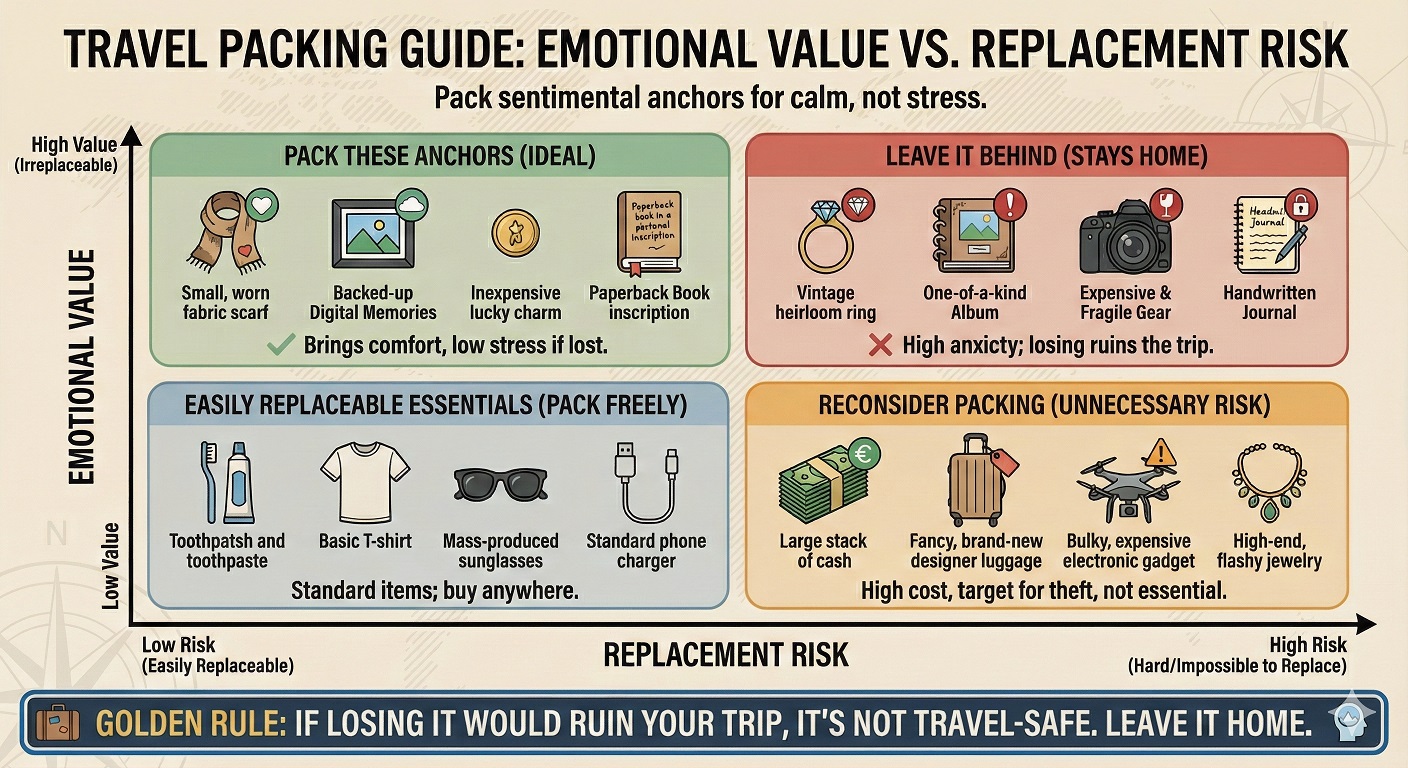
Visual: Emotional value vs replacement risk
Pack sentimental anchors that bring calm, not stress. If losing it would ruin your trip, it’s not travel-safe.
Before you fly: weigh the whole bag
First, pack everything you will carry, including liquids, electronics and the bag itself. Then check each airline’s own rules. IATA explains that allowances vary by airline, cabin and aircraft.
Also keep power banks and spare lithium batteries in cabin baggage under the applicable airline rules. Finally, check medication restrictions and permissions for your destinations; a minimalist list must still cover your health and accessibility needs.
Downloads & FAQ
A quick toolkit for the practical stuff—plus answers to the questions that derail packing plans at midnight.
Downloads & tools
FAQ: Packing for long-term travel
How heavy should my backpack be for 6+ months of travel?
A strong target is 6–7 kg (13–15 lb) if you’re trying for carry-on-only, and 8–10 kg (18–22 lb) if you need a bit more flexibility. If your bag feels “fine” in your bedroom but brutal after 30 minutes walking, it’s too heavy.
What’s the biggest mistake people make when packing for long trips?
Packing for every imagined scenario. Long-term travel rewards adaptability. Pack a repeatable core kit, then buy/replace items on the road as real needs show up.
Can I bring sentimental items while traveling long-term?
Yes. For example, choose a small, travel-safe item. Choose items that provide daily comfort but aren’t irreplaceable, like a wearable keepsake, a pocket journal, or a small printed photo.
Join the conversation
What’s your go-to packing hack—and what’s the one thing you always regret bringing? Drop it in the comments. Your tip might save another traveler’s shoulders (and sanity).