TRAVEL FIELD NOTES · YOUR FIRST ADVENTURE
Young Travel: Create Your Own Lifequake
You can spend three hours researching a phone upgrade. Give your first adventure at least the same attention. It might change rather more than your camera.
Another sunset. Another street market. Another person apparently living their best life while you are looking for your charger.
Perhaps it is time to give yourself something worth charging it for.
By Rob Wheatley – Program Director & traveler
Updated 16 October 2026

Young travel is your chance to explore beyond the familiar, make your own decisions and discover what you enjoy when nobody else has written the timetable. Start with a weekend, join a group or plan something longer. The point is to take a manageable first step.
I call it a lifequake: a journey that shakes up what you thought you knew about the world, and occasionally yourself. Preferably without shaking all the money out of your bank account.
Skip to: Under 18? · Money · Solo or group? · Phone habits · My first step
Your trip, your rules—with a little small print
One of the great pleasures of travelling independently is discovering that you can spend an entire afternoon doing something nobody at home would understand.
Wandering through a market. Following a walking trail. Sitting in a square because someone is playing a guitar rather well. You do not have to justify it to a committee.
You also discover that independence includes finding your accommodation, feeding yourself and working out why the train you confidently boarded is going somewhere else.
Freedom has admin. Nobody puts that on the brochure.
But there is a particular satisfaction in figuring things out. The first unfamiliar journey you manage. The conversation you start despite knowing six words of the language. The evening you arrive somewhere new and realise, “Actually, I can do this.”
Yes, take the photographs. However, some of the best things you bring home will be invisible: confidence, a broader perspective, a friendship that began with someone asking whether this was the right platform.
Hopefully, one of you checked.
You do not need a gap year to get started
If you have the opportunity, money and inclination to travel for six to twelve months, I would certainly encourage you to consider it. There is something valuable about stepping outside the routine long enough to question whether it suits you.
But a year abroad is a substantial commitment. Study, work, family responsibilities and money do not politely disappear because you have bought a backpack.
A week counts. So does a weekend somewhere unfamiliar. Start with a trip you can afford and organise. Give yourself enough of a challenge to feel stretched, with enough support to enjoy it.
You are going travelling. You do not need to audition for a survival programme.
Your first tiny win
Name one place you could realistically visit. Choose roughly when, for how long and who might come. You now have the beginnings of a trip.
At 16 or 17, check before you book
There is a practical difference between wanting independence and being old enough to book every part of it.
If you are under 18, involve a parent or guardian early. Check the official requirements for your nationality, destination and journey, including any consent documents. Then check the actual age policies of your airline, accommodation and tour operator before paying.
For example, YHA in England and Wales has specific rules for under-18 guests. Other providers have their own policies.
A school trip, supervised youth programme or journey with a trusted adult may be the right starting point. You can still help choose the route, manage your spending and organise activities.
Independence is something you build, rather than something that arrives fully assembled on your eighteenth birthday.
Young travel on a realistic budget
The destination may win your heart. The total cost needs a look-in before you book.
A cheap flight is only one piece. Add accommodation, food, local transport, entry fees and getting home. Check document costs, insurance and activities you already know you will want to do. Then leave room for things changing.
Money for an unexpected problem is not spare money for your final night out.
- Price the whole trip. Include unglamorous bits such as airport transfers.
- Set a daily allowance. Choose a figure that does not require surviving on optimism.
- Protect an emergency reserve. Keep it separate from spending money.
Travelling more slowly, visiting fewer places or staying closer to home may give you a better experience than squeezing six cities into a week and remembering mainly their stations.
Make the savings target real
Trip cost + emergency reserve − money already saved = savings target.
Divide that target by the number of months before departure. If the monthly amount is unrealistic, change the trip or the date.
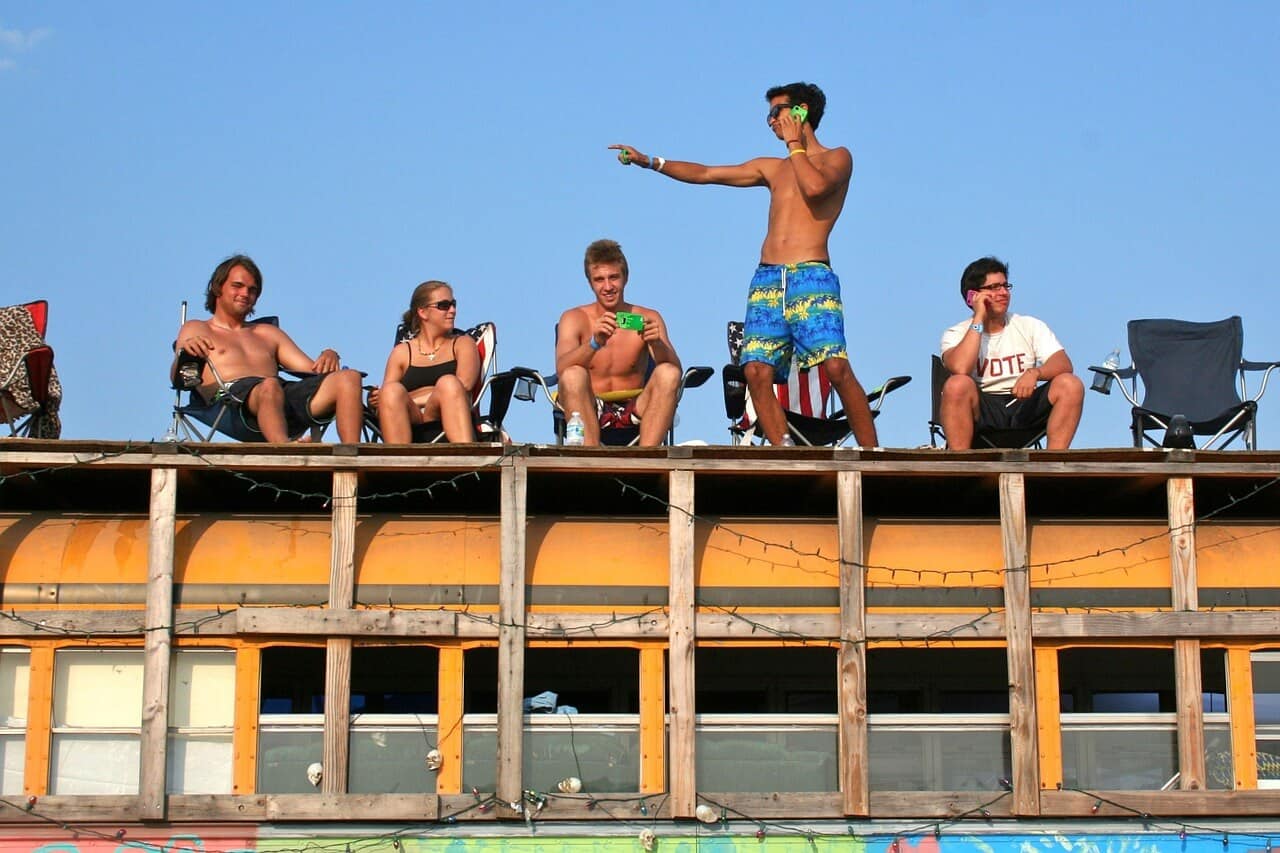
Would a group trip suit you?
For a first trip abroad, an organised group can be an excellent introduction. It can handle much of the transport and accommodation planning, give you company and provide someone to ask when you are unsure what happens next.
There is no medal for making your first journey unnecessarily difficult.
Contiki’s standard trips are for 18–35s. However, age is only the first filter. Check pace, accommodation, group size, free time and activities.
“People my age” does not guarantee you all want to spend Tuesday the same way.
Compare the full price. Group travel is not automatically cheaper. Check meals, optional activities and extras: flights to and from the tour, visas and insurance may be excluded.
A tour leader gives you support. You still need to understand your documents, insurance and personal responsibilities. Someone else can organise the coach. You still have to get on it.
Which sounds like you?
“I want support and company.” Look at a suitable organised trip.
“I want freedom, with company sometimes.” Try independent travel with bookable activities.
“I want to go with friends.” Agree the budget and pace before anyone pays.
Going independently? Make the first few days easy
Travelling independently does not require leaving every decision until you arrive.
Book your first accommodation. Work out how you will get there. Save the address and essential information offline, and let someone you trust know your plans.
If possible, give yourself an uncomplicated arrival rather than navigating an unfamiliar place late at night with a flat phone.
After that, leave some room. A walking tour, shared activity or hostel event can help you meet people without announcing to a room full of strangers that you are available for friendship.
And remember: solo travel does not mean spending every waking moment alone. Company on Tuesday and a quiet Wednesday afternoon are both allowed.
Use your phone without letting it direct the trip
Your phone can translate a menu, find a bus and help you avoid walking forty minutes in the wrong direction. It can also convince you that your perfectly good afternoon is inferior to a stranger’s heavily edited one.
Use social media for ideas, then check practical details elsewhere. The wonderful swimming spot may be difficult to reach. The restaurant may need a booking. The peaceful viewpoint may have a queue just outside the photograph.
- Save the idea; check the reality. Look at recent reviews, access and costs.
- Share thoughtfully. Avoid posting your accommodation details or your precise live location when alone. Keep someone you trust informed privately.
- Take the photo, then look up. Have something to remember beyond the pictures.
Nobody needs fourteen attempts at you looking spontaneously delighted.

Could working abroad help you stay longer?
Possibly—but arrange the work around the rules, rather than assuming the rules will arrange themselves around you.
Teaching English is worth researching if you enjoy teaching and meet the requirements. Pay, qualifications, hours and living costs depend on the country, employer and programme.
The British Council’s English Language Assistant programme, for example, has its own eligibility criteria and placement conditions. It is something to investigate, rather than an opportunity everyone automatically qualifies for.
Establish what you would earn, what accommodation costs, what the job involves and whether you can legally do the work. Check official immigration information before committing; permission to visit is not automatically permission to work.
Most importantly, choose teaching because you want to do the work as well as experience the country. Being able to order lunch in English does not, by itself, make you ready to teach a classroom.
You are allowed to be nervous—and to dislike bits of it
You can be excited about travelling and quietly terrified of arriving. Both feelings can fit in the same suitcase.
There may be a lonely evening. You might miss home, struggle with the language or discover that sharing a dormitory has certain acoustic disadvantages.
None of this automatically means you made a mistake. Eat something, rest and give yourself time before judging the entire trip. Speak to someone you trust if you need support. If a place or situation feels wrong, change your plans.
You are allowed to leave a party, decline an invitation or spend money on a safer way back. Confidence includes knowing when to say, “This is not for me.”
Beware the “yeah, but”
The “yeah, but” can become a remarkably efficient way of staying exactly where you are.
Yeah, but I’m nervous. Yeah, but nobody can come with me. Yeah, but I don’t have enough money.
Some of those are real obstacles. Take them seriously. Then work out whether they need a solution, a smaller trip or more time.
If money is tight, start closer to home. If travelling alone feels too much, consider a suitable group. If a year is impossible, look at a week.
Perhaps your lifequake will be quieter than you expect. You will solve a problem, make a friend or question something you had always assumed. Discover that the world is larger than your routine—and that you can find your way through a little more of it than you thought.
Choose somewhere. Work out what it will take. Give yourself a first step you can actually take.
You can buy the dramatic backpack later.
Your next 15 minutes
- Pick your realistic first destination.
- Set a rough spending limit and start a savings target.
- Check your passport and booking age requirements.
- Open the World Travel Course to build the rest of your plan.
What is your “yeah, but”?
Money, nerves, paperwork or finding someone to go with? Tell me what is holding you back—and where you would like your first adventure to take you.
Plan your first trip
One useful next step at a time.
Save for the trip →
Set a savings target.
Make your money go further →
Where to save and where to spend.
Sort your documents →
Passports, visas and paperwork.
Check your insurance →
Choose cover for your plans.
Solo or group? →
Find a comfortable starting point.