ROB’S BLOG • ADVENTURES & MISADVENTURES
Eleven Days, Thirty-Eight Strangers, and One Very Patient Bus Driver
By Rob Wheatley – Program Director & traveler | Around the World with Rob
Published 11 October 2026 · A story from the road
People don’t tell you that a group tour is basically a floating soap opera with better scenery.
An escorted tour of Italy. Thirty-eight personalities. One departure time.
I have been a cruise director. I have herded two thousand passengers onto tenders in a swell, and I have talked a man out of the ship’s pool at 3 a.m. So when I tell you I will never do group travel again, understand that I say it as a professional.
A few years ago I booked an escorted tour of Italy with a well-known company. I won’t name it, because they were lovely and I’d like to keep it that way. The brochure promised “Rome, Florence, Venice and the soul of Italy in eleven effortless days.”
Effortless. I laughed at that word for roughly forty minutes after we met.
Day One: The Cast Assembles
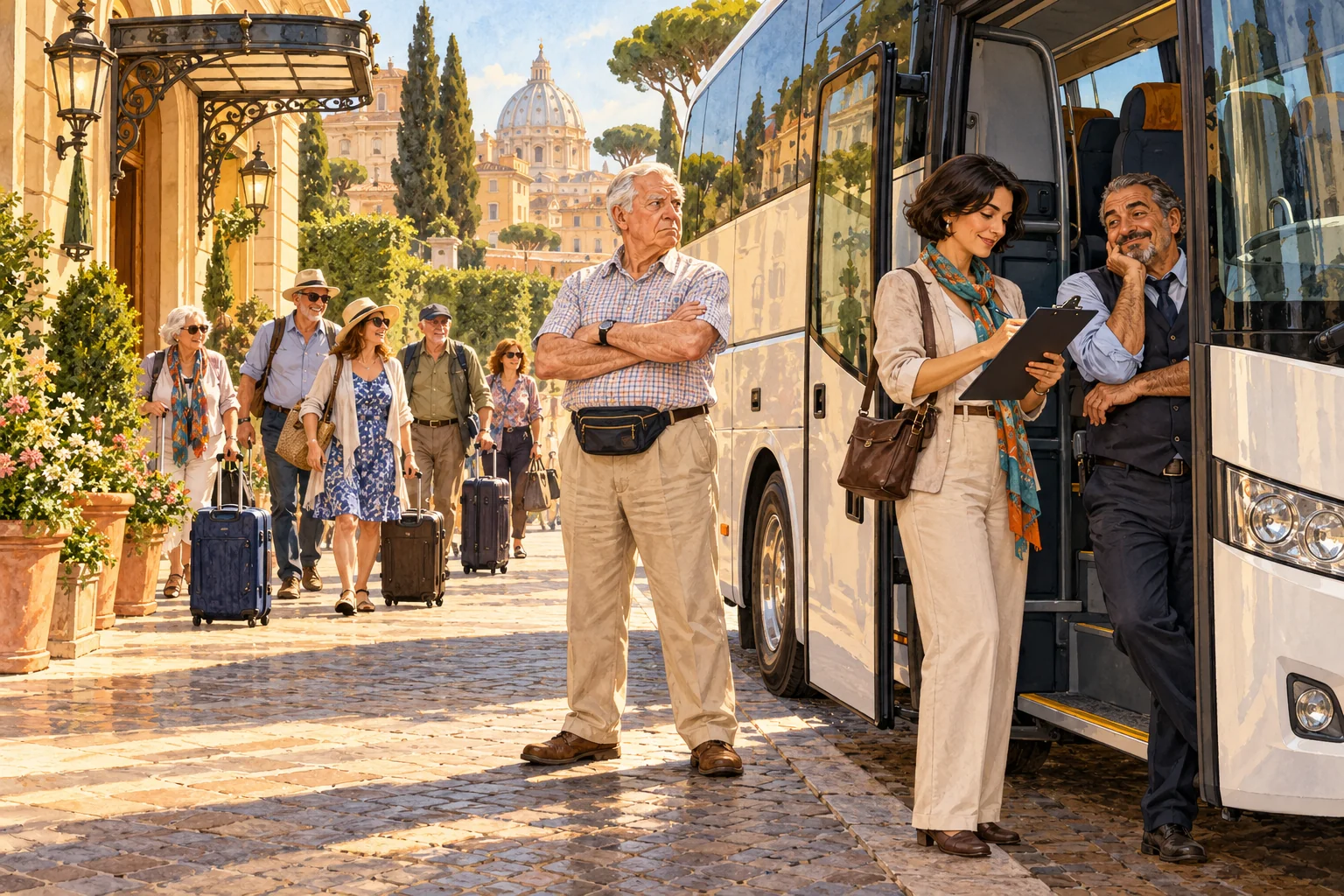
Our meeting point was a hotel lobby in Rome, and thirty-eight people stood in it, pretending not to size each other up. I’ve since learned that every group tour assembles the same cast, as if sent by a central casting agency.
First, Harold. Seventy-six, retired surveyor from Leeds, wearing a bumbag that I’m fairly sure held every receipt he’d earned since 1994. Harold arrived at every departure twenty minutes early and stood beside the bus with his arms folded, like a bouncer for a club nobody wanted to join.
Then Denise, from Connecticut. Denise had opinions. The pillows were too flat, the espresso too small, the Colosseum “a lot more rubble than the pictures.” She asked our guide whether the Trevi Fountain “came with a less crowded option.”
Denise was not a bad person. She was a person who had paid for perfection and was personally auditing Italy’s delivery of it.
Then Kyle, a twenty-four-year-old Australian travelling with his mum, who had bought the trip as a graduation gift and was about to regret it. Kyle’s mum went to bed at nine. Kyle did not.
By day three, Kyle knew every bartender within a two-kilometre radius of every hotel, and several of them knew his full name, his star sign and his opinion of Tottenham.
Add a pair of German engineers who treated the timetable as scripture, a Brazilian family of five who treated it as a suggestion, three Canadian sisters in matching rain jackets and their niece Brittany, a honeymooning couple who vanished after breakfast and reappeared only for boarding, and a quiet widow named Doreen from Cornwall.
And holding it all together, our tour leader Giulia, a woman of tremendous grace who I’m convinced had a black belt in something.
The Rules of the Road
Giulia’s first speech was brief. “The bus leaves at 8:30. Not 8:35. Not ‘I’m coming’. 8:30.”
The Germans nodded gravely. The Brazilians smiled warmly, the way you smile at a child who has promised to eat vegetables.
We were late on day two. Not because of the Brazilians, mind you. The culprit was Harold.
He had finally lost his composure over a €2 discrepancy on a hotel minibar bill and was in the lobby, receipts fanned like a poker hand, explaining to a baffled receptionist the principle of itemisation.
The bus idled. The Germans checked their watches in unison. I believe one of them sighed in two languages.
The Great Document Crisis
Every group trip has a document crisis, and ours arrived in Florence, just as the bus was about to pull out of the car park.
“Has anyone seen Kyle?” asked Giulia, counting heads for the third time.
We had not. We were thirty-seven. His mum, who had somehow aged a decade since Rome, said calmly, “He’s probably still asleep.”
He was.
Giulia marched back into the hotel and returned four minutes later with Kyle, looking like a man who’d been woken by a fire alarm and informed it was his own fault. He climbed on, found his seat, and then went the colour of old mozzarella.
“My passport,” he said. “It’s in the safe. In Rome.”
I would like you to picture a coach full of thirty-seven people, most of them sleep-deprived and one of them Denise, absorbing this information. Nobody spoke. Somewhere in the back, a Canadian sister quietly unwrapped a granola bar.
Giulia, to her eternal credit, made four phone calls in rapid Italian, and by lunchtime the Rome hotel had couriered the passport onto a high-speed train and into the hands of a very confused man named Marco at Florence station.
Kyle bought Marco lunch. Marco, I believe, now sends him Christmas cards.
The Hospital Visit
I should mention that Denise’s feet had been complaining for days. She’d arrived in white fashion trainers, “because the guidebook said Italy is stylish,” and had spent three days on cobbles that seemed to have been laid by engineers who clearly hated ankles.
On the steps of the Duomo, she went over. There was a small crunch, a very large word I won’t repeat on a family website, and a chorus of gasps.
Giulia had her in a taxi in a minute flat. And because, by then, nobody wanted anyone to face the drama alone, six of us volunteered to go along, which is how I came to spend an afternoon in a Florentine hospital waiting room with Harold, Doreen, a Canadian sister and two Germans.
It was glorious.
Harold, having finally found a captive audience, delivered a full lecture on the history of surveying. The German engineers asked sharp questions. Doreen brought out a flask of tea from her handbag, which I now consider the single greatest piece of travel preparation I have ever witnessed.
Denise emerged from X-ray with a sprained ankle, a crepe bandage, and an expression I can only describe as dreamy.
“The doctor,” she whispered, “was very kind.”
The doctor was twenty-nine, tall, and named Matteo. For the next two days Denise did not utter a single complaint about the pillows.
Love in the Time of Itineraries
Which brings me to the romance. In a group tour, the itinerary is only half the programme.
Kyle, true to form, spent Venice in the company of Brittany, the Canadian sisters’ niece—a Vancouver law student who did not appear to be a fan of early nights either.
By Venice they were inseparable, a pair of grinning conspirators who kept disappearing down alleyways and reappearing with gelato and no explanation.
But the real love story, and I say this with total sincerity, was Harold and Doreen.
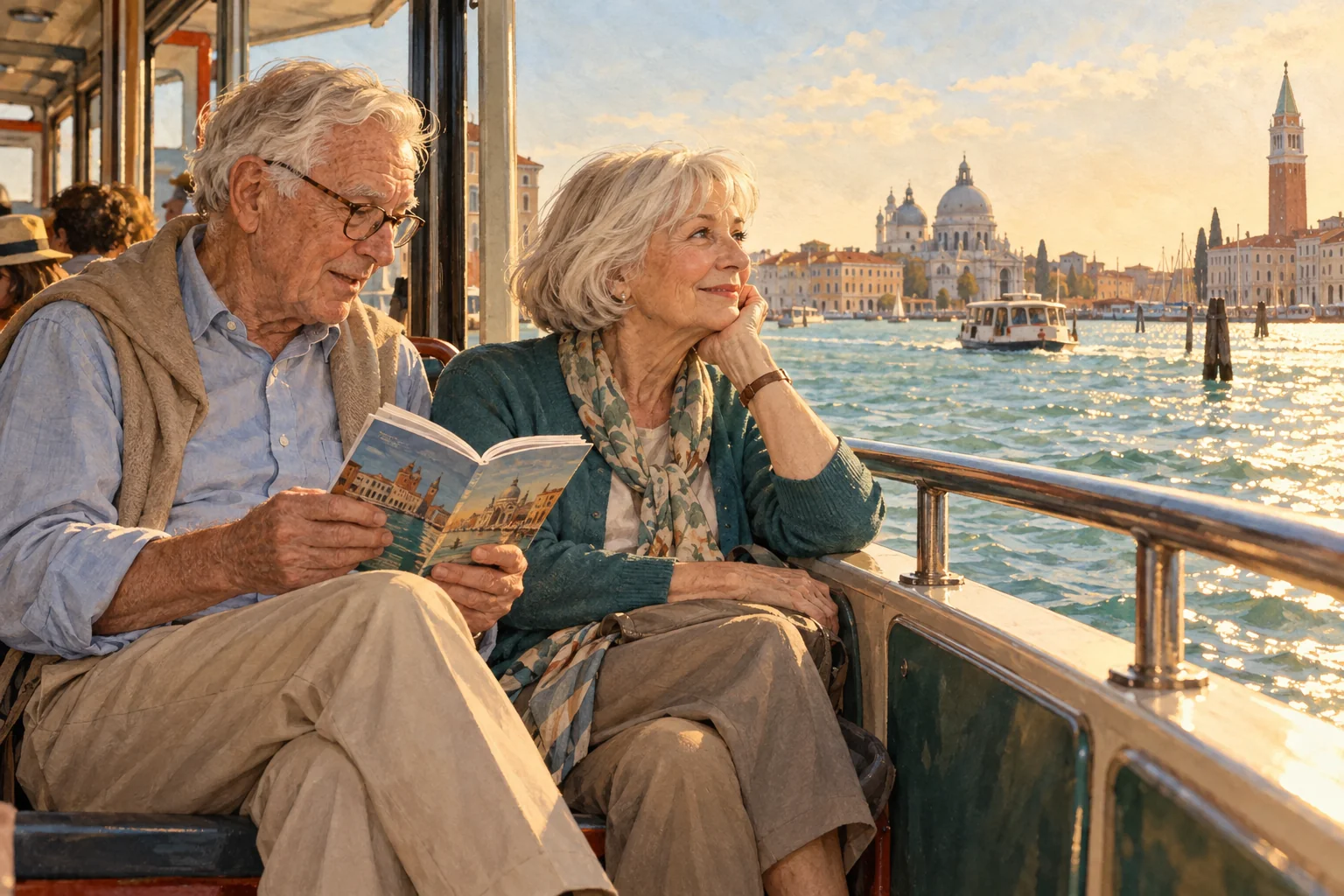
It crept up on us. First, Harold carried her bag up the hotel stairs. Then they sat together on the bus. Then on the vaporetto I caught him reading her the notes from his guidebook, with the intensity of a man proposing a boundary survey, while she gazed at the lagoon and smiled.
By the farewell dinner, he’d stopped carrying receipts. I nearly wept into my risotto.
Lost in Venice
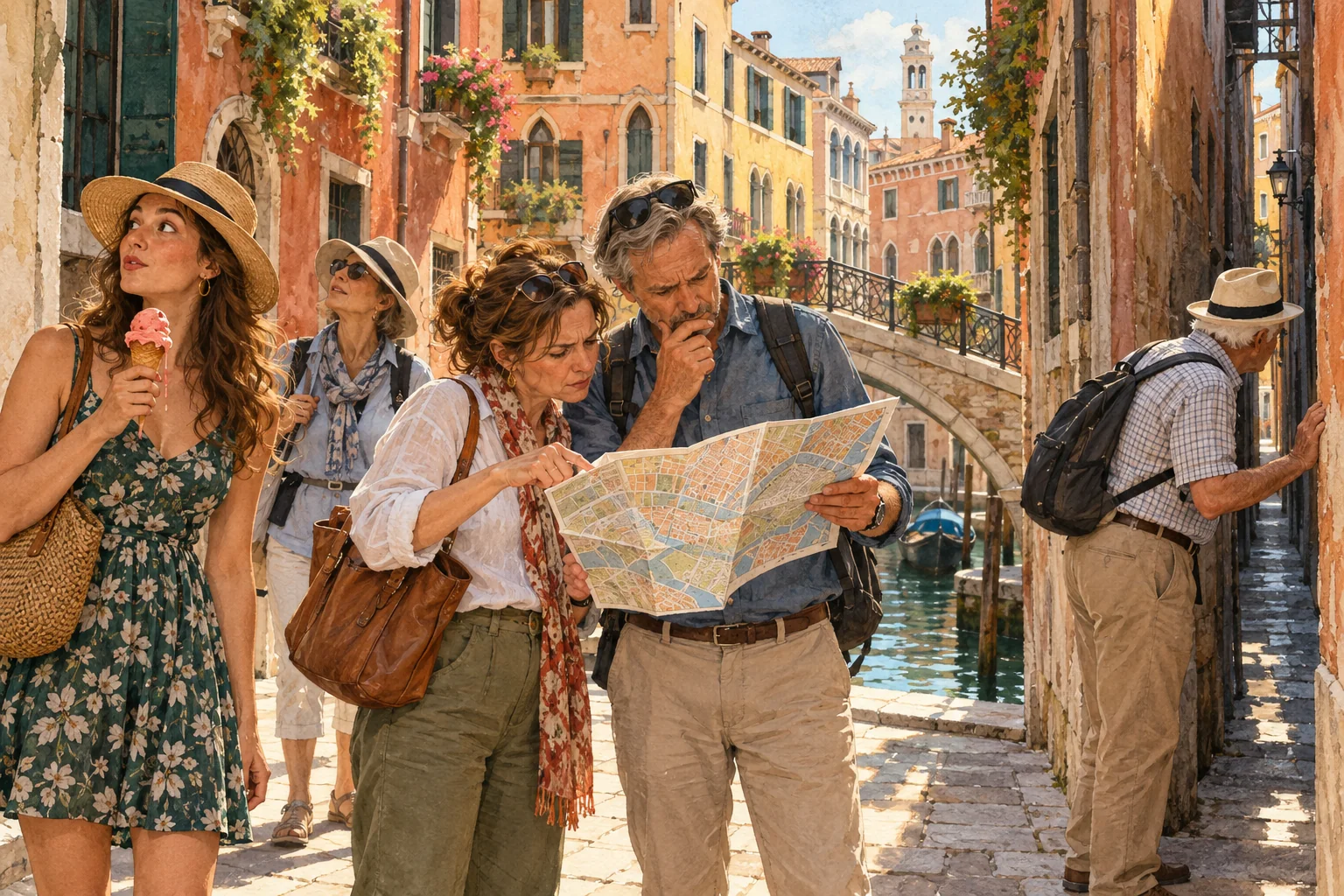
Of course, no Italian tour is complete until at least four people are lost in Venice. This is not an accident; this is a feature of the city, designed by medieval architects who hated tourism before it existed.
Giulia gave us a very clear map and an even clearer instruction: “If lost, find the Rialto, then wait.”
Fourteen of us got lost within twenty minutes.
The Brazilian family turned up three hours later, triumphant, holding a bag of glass beads they’d bought from a man who “knew a shortcut.”
The Germans, who had been following the map by compass, arrived at the exact meeting point ninety seconds early and then had nothing to do but watch the rest of us stagger in, sunburnt and sheepish, like soldiers returning from some very minor war.
I got lost too. For the record, I had been a cruise director.
I spent forty minutes circling a church, then ended up in a bakery where an elderly woman pointed me toward the Rialto without a word, as if she did this forty times a day. She probably did.
The Verdict
So why would I never do it again?
Because I like to wander. I like to wake at 6 a.m. and drift to a café before anyone’s out, point at what the man behind the counter is eating, and spend the morning following a street because I like the way the light falls on it.
I like being late, and getting lost on purpose. Group travel is the opposite of all that. It’s a beautiful, beautifully run machine, and I am a bit of sand.
And yet.
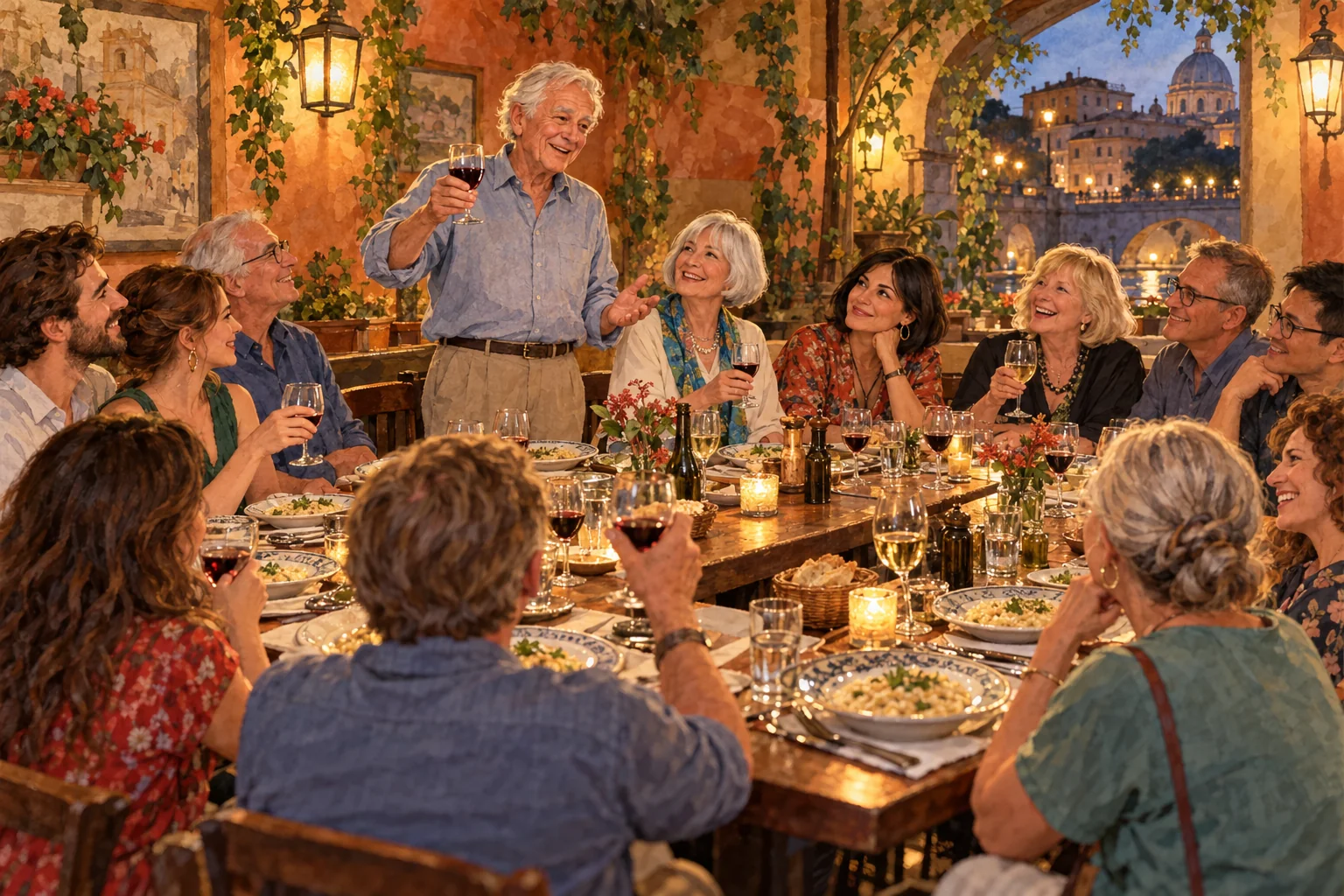
On our last night, in a tiny trattoria in Trastevere, Giulia pushed all the tables together into one long table, and thirty-eight strangers, who had by then shared a hospital waiting room, a lost passport, two missed buses and a genuine love story, sat down to eat.
Harold stood up and made a speech. It was about receipts, but also, somehow, about friendship.
Denise cried. The Germans cried and denied it. Kyle’s mum, who had never once been out past nine, stayed until midnight and danced with Marco, the courier, who had come as a surprise guest.
I have not seen most of those people since. But I still get a card from Doreen at Christmas. It’s always signed “Doreen and Harold.”
I will never do group travel again. I say that firmly, and with a small smile, because I know that if Giulia rang tomorrow and told me there was a seat on the bus, I’d probably already be in the lobby.
Twenty minutes early. Arms folded.
Don’t tell Harold I said so.