Fear of flying can destroy your life if you let it
Flight anxiety once dictated where I could go, how I travelled and what I was willing to miss. Learning what was happening inside both the aircraft and my own head changed everything.

Fear of flying can shrink your world long before you ever reach an airport. For some people, flight anxiety means a few miserable hours in the air. For others, it changes holidays, relationships, family visits and even careers. I know because, for years, I allowed it to change mine.
In my late teens and early twenties, I could be excited about a destination and terrified of the one thing that would get me there. The anxiety often started weeks before departure. By the time I reached the gate I had already rehearsed every possible disaster, and I cancelled more flights than I care to admit.
That is the frustrating thing about aviophobia, another name commonly used for fear of flying. You can know that your reaction is excessive and still feel every racing heartbeat, every shallow breath and every urge to escape as though the danger were standing directly in front of you. The fear is not imaginary simply because the risk is small.
How reasonable is a fear of flying?
Statistically, commercial air travel is extraordinarily safe. A 2024 MIT analysis of worldwide commercial aviation safety found an overall risk of one fatality per 13.7 million passenger boardings during 2018–2022.
But statistics only get us so far. A phobia is not a spreadsheet problem. You cannot necessarily talk your body out of panic by showing it a probability table. The numbers can provide context; they cannot do the emotional work for you.

That was certainly true for me. I could understand the safety argument perfectly well and still feel my stomach tighten the moment I heard an engine spool up.
“A tube with wings, weighing tons, heading thousands of feet into the sky, full of people and luggage? My younger brain had a very simple response: absolutely not.”
What flight anxiety felt like for me
I remember the suffocating claustrophobia that hit the moment I stepped onto an aircraft. Rapid breathing. Racing pulse. That horrible certainty that something terrible was about to happen. During take-off, every sound became evidence in a case my imagination had already decided I was going to lose.

Eventually my career forced my hand. I still did not enjoy flying, but avoiding it was becoming increasingly difficult. Weeks before a trip, that familiar gnawing feeling would arrive. I white-knuckled take-offs, watched the wing during every bank and treated each bump of turbulence as though the aircraft had just received very bad news.
Worse, I hid the fear. I was embarrassed by it. I wanted to travel, yet I would quietly angle for a train, bus or very long drive if it meant I could avoid boarding an aircraft. Flight anxiety had started making decisions for me.
How I started overcoming my fear of flying
Eventually I became more fed up with the fear than I was frightened of the aircraft. That mattered.
I bought a flight simulator and taught myself the basics of flying a desktop cockpit. I started reading navigation charts, learning what the different phases of flight looked and sounded like, and understanding why an aircraft banks, climbs, changes power and makes all those noises passengers rarely get explained.
The machine became less mysterious. Later, I had the opportunity to sit in the jump seat on a few commercial flights. Seeing the crew at work — calm, methodical and very busy doing entirely ordinary things — gave me a perspective no safety statistic had managed to provide.
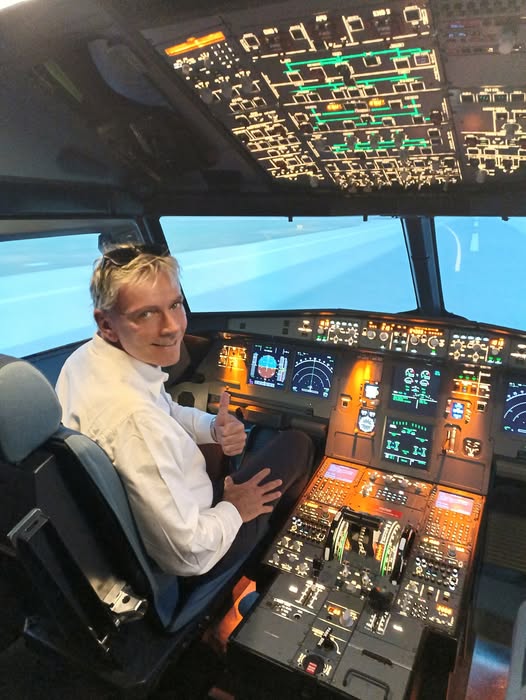
Perspective was my breakthrough. From a passenger window, a perfectly normal bank can look dramatic. An engine-power change can sound ominous if you do not know why it is happening. Once I understood those sensations, they stopped writing the story for me.
Curiosity eventually became a hobby, and I went further and trained for a single-engine pilot's licence. I am certainly not suggesting every nervous flyer should do that. My response was unusually enthusiastic. The useful lesson was much simpler: familiarity took away some of the mystery that fear had been feeding on.
“Perspective is everything. Once I understood what was happening in the cockpit, the aircraft stopped feeling like an unknowable machine doing things to me.”
How to overcome fear of flying: what actually helps?
My route was personal, but there is a more evidence-based answer for someone whose fear of flying is interfering with everyday life. The U.S. National Institute of Mental Health describes exposure therapy — a form of cognitive behavioural therapy (CBT) — as particularly effective for phobias. The idea is not to throw somebody into the most frightening situation imaginable. It is to confront feared situations progressively and safely rather than reinforcing the cycle of avoidance.
The American Psychological Association's discussion of aviophobia also describes psychologists using exposure-based approaches to help people with fear of flying. Depending on the person, that work can involve talking through triggers, simulations, airport exposure or eventually an actual flight.
That makes intuitive sense to me because avoidance had been one of the things keeping my own fear alive. Every cancelled flight gave me immediate relief — and quietly taught my brain that escaping the aircraft was the reason I had survived.
A practical pre-flight routine for a nervous flyer
- Work out what you are actually afraid of. Crashing, turbulence, claustrophobia, loss of control and panic itself are different triggers and may need different strategies.
- Tell the cabin crew that you are nervous. You do not need a dramatic announcement. A quiet word while boarding can stop you feeling as though you are handling the entire experience alone.
- Rehearse your coping routine before travel day. Slow breathing, grounding or a therapist-taught technique is far easier to use when it is familiar rather than something you first discover at 35,000 feet.
- Keep your seat belt fastened whenever you are seated. That is also the FAA's advice for turbulence safety.
- Do not judge progress by whether you feel zero anxiety. A successful flight can be one in which you felt frightened and still stayed with the experience.
- If the phobia is controlling your life, get qualified help. A mental-health professional can help you build an exposure plan appropriate to the severity of your fear.
What fear of flying can cost you
Years later, when I was working as a Cruise Director, I began seeing versions of my own old fear in guests. Some people chose a cruise specifically because a spouse or partner was terrified of flying. I met travellers who would spend days driving or taking trains to reach a Florida port because getting onto an airliner felt impossible.
One woman told me that she had watched her grandchildren grow up largely through video calls. She lived in Florida; her daughter's family lived in Los Angeles. The miles were manageable. The aircraft was not. That stayed with me because it showed how a fear of flying can alter far more than a holiday itinerary.
Another guest told me he had lost his job after being promoted into a role that required regular domestic and international travel. When the first trip arrived, his fear was strong enough that he gave up the promotion. His former position had already been filled.
That is why I use strong language about this subject. Severe flight anxiety can close doors quietly. You adapt around it. Then, one day, you realise how many decisions have been made by the fear rather than by you.
Fear of turbulence: the demon inside the demon
Even people who are reasonably comfortable flying can become nervous when the seatbelt sign chimes and the cabin starts moving. For someone already dealing with aviophobia, turbulence can feel like proof that every anxious thought was correct.
I remember that escalation perfectly. A few bumps. Then a stronger one. Cutlery rattles. Conversations stop. My attention narrows until I am monitoring every movement of the aircraft and every expression on the crew's faces.
What I understand now is more nuanced than the old reassurance that “turbulence is nothing.” Turbulence is real, and sufficiently strong turbulence can cause injuries in the cabin. What matters is that pilots, airlines and regulators treat it as a known operational hazard, and passengers can reduce their own injury risk by staying restrained when seated.
The FAA's current passenger guidance is refreshingly simple: keep your seat belt buckled whenever you are seated, obey the seatbelt sign, listen to the crew and pay attention to the safety briefing. That is a better takeaway than pretending a rough ride is impossible or trying to decode every bump yourself.
The facts about turbulence that helped me
- Turbulence is expected. Flight crews receive weather information, pilot reports and forecasting tools specifically to help them anticipate or avoid rough air where practical.
- Your seat belt is your simplest protection. The FAA repeatedly emphasises restraint because unexpected turbulence can occur even when the cabin seemed calm moments earlier.
- A change in route or altitude is not evidence that the aircraft is in trouble. Crews may deviate to find a smoother ride and reduce the chance of cabin injuries.
- Your fear response can exaggerate the meaning of normal movement. This was one of the biggest lessons for me: sensation and danger are not the same thing.
Taking back your freedom from flight anxiety
I cannot promise that everybody with a fear of flying will one day enjoy take-off. Nor should “loving aviation” be the benchmark. The real goal is much more useful: being able to make a travel decision because you want to go somewhere, not because anxiety has quietly removed the aircraft from the list of possibilities.
For me, understanding flight helped enormously. For somebody else, the turning point may be CBT, structured exposure, a fear-of-flying programme or simply admitting that the problem has become too restrictive to keep working around.
“If you can stop fear from making the decision for you, the map of your life gets bigger again.”
If you are beginning that process, be realistic rather than heroic. You do not need to prove anything by booking the longest flight you can find. What matters is moving from avoidance toward understanding and, where necessary, getting proper support. That is how my own world opened up again.
Continue with air travel
If flying itself is only one part of the stress, my Air Travel guide brings together the practical side of airports, flights and making the journey easier.
Have you dealt with fear of flying or flight anxiety? I would genuinely like to know what made the biggest difference for you — understanding the aircraft, therapy, repeated flying, a particular routine, or something else entirely.